Thinking about cataract surgery? Get an independent assessment before you choose a surgeon — or a lens
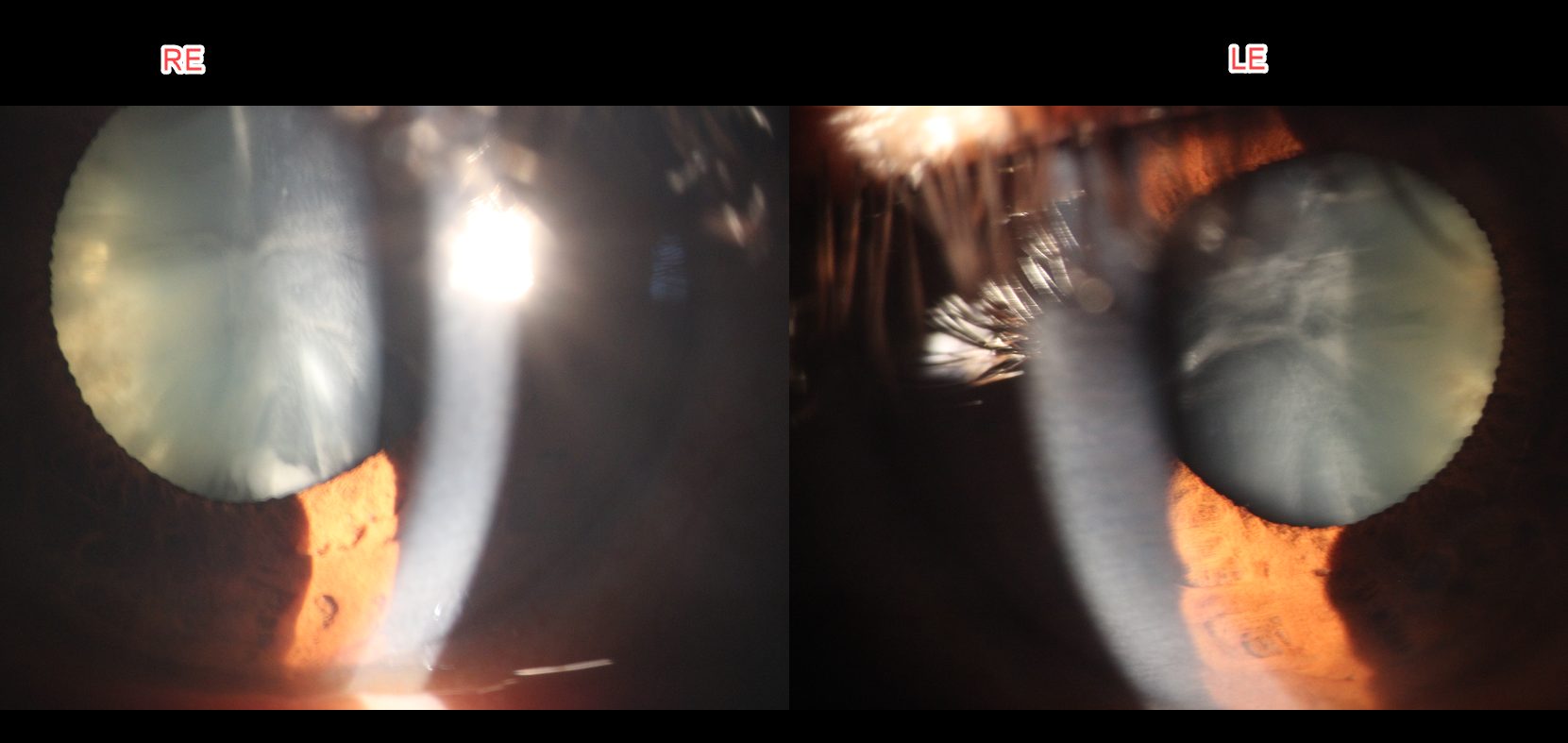
Modern cataract surgery is not one decision — it is a series of them. Do you need surgery yet? Does your insurance cover it? Which surgeon and which hospital? And the question with the longest-lasting consequences: which lens goes in, because the implant you choose determines how you see for the rest of your life. At Rose Optometry we offer a private, independent cataract and refractive surgery assessment — we are an independent Hamilton practice, not owned by any surgical provider, so the advice you get here serves exactly one interest: yours. Book in with one of our optometrists to explore your options, and when you are ready we process the referral with your imaging, measurements and insurance case attached. The photographs above show both of one patient's cataracts against the eye's red reflex — the documentation that supports both the surgical decision and the insurance claim.
Measured like a surgical eye: ANTERION imaging and OKULIX ray tracing
The accuracy of your final vision is decided before surgery, in the measurements. Your eye is imaged on the Heidelberg ANTERION — swept-source OCT that maps the cornea's front and back surfaces, measures the eye's length, and images the cataract in cross-section. Those measurements feed OKULIX ray-tracing software, which calculates lens power by simulating light through your individually measured cornea rather than population-average formulas — particularly valuable after previous laser vision correction, in unusually long, short or irregular eyes, and for premium lens planning. Your surgeon receives these scans and calculations with the referral.
Will your insurance fund it?
Southern Cross funds cataract surgery when there is clinically significant lens opacity and best-corrected vision of 6/9 or worse — or, with better vision, when specific alternatives apply: more than 2 dioptres of difference between the eyes caused by the cataract, posterior subcapsular or cortical cataract with documented glare problems, or (over 60) a myopic shift greater than 2 dioptres. Lens extraction purely to correct refractive error or presbyopia is excluded. Our assessment documents you against these criteria — acuity, glare testing and photographs — so the claim is supported before the referral is sent. Other insurers publish similar criteria; your policy terms apply.
The lens decision: an honest tour
Standard monofocal (± toric) — one sharp focus, usually distance, reading glasses expected, and the lowest rate of visual side effects; the funded default and still the right choice for many eyes. Enhanced monofocal (J&J TECNIS Eyhance; Rayner RayOne EMV, designed with Prof Graham Barrett for blended mini-monovision) — stretches focus into intermediate distance with a monofocal-like side-effect profile. Extended depth of focus (Alcon Vivity; J&J TECNIS PureSee, a purely refractive design with no diffractive rings and a near-monofocal halo profile) — continuous distance-to-intermediate vision with functional near. Full range without rings — Rayner's RayOne Galaxy spiral optic and Lenstec's segmented ClearView 3 blend focus continuously with low reported halo, though as newer designs they carry shorter track records. Diffractive trifocals (Alcon PanOptix; J&J TECNIS Odyssey; B+L enVista Envy) — the maximum spectacle independence, with haloes around lights at night the honest trade-off most people adapt to. Every lens here is a good lens in the right eye and the wrong lens in the wrong one — which is exactly the suitability call the assessment exists to make. Insurers generally fund surgery with a standard lens; premium options usually carry an additional cost quoted by the surgical practice.
Cataract surgery when you have keratoconus
Keratoconus is one of our subspecialties, and it changes the rules: an aspheric monofocal is the usual default, diffractive multifocals are generally avoided on an irregular cornea, and toric lenses need a conversation with us before surgery. Many keratoconus patients get their best vision from a rigid (RGP or scleral) lens fitted after cataract surgery — and a rigid lens neutralises the corneal astigmatism itself, so a toric implant chosen against that same astigmatism can leave cylinder inside the eye that no contact lens corrects well. Talk to the optometrist who fits your rigid lenses before the implant is chosen; we put that recommendation in writing in our referral.
Where we refer: Hamilton's cataract surgeons
Because we are independent we refer across all of Hamilton's private practices, matching surgeon, platform and lens availability to your eyes and insurance pathway: Hamilton Eye Clinic (130 Grantham Street, 07 834 0006 — ten surgeons operating at Bridgewater Day Surgery); Laser Eye Centre (22 Thackeray Street, 0800 733 2020 — Drs Patil, Merriman, Hoy and Carey on ZEISS platforms); Eye Institute Hamilton (Level 2, 1 Cook Street, 07 847 2760 — Dr Andrew Thompson and Dr Verona Botha); and Mr Chris Murphy at Flagstaff Eye Care (1158 River Road, 07 957 2758 — cornea, anterior segment and cataract, operating at Southern Cross Hospital). We also perform your aftercare here in Frankton once the surgical review period ends.
Explore your options
Book a comprehensive examination and cataract assessment — measurements, photography, insurance documentation and an unhurried conversation about lenses: new patient examination or existing patient examination, or ring 07 847 3195.
Frequently asked questions
What causes cataracts?
Age is the overwhelming cause — the eye's natural lens slowly clouds as its proteins change — accelerated by UV exposure, smoking, diabetes, long-term steroid use, previous eye injury or surgery, and family tendency. Nuclear, cortical and posterior subcapsular cataracts are the three common patterns.
When should cataracts be treated?
When they interfere with your life — driving, reading, glare at night — not merely when they exist. Insurance adds a measurable threshold, and our assessment measures you against both honestly, including telling you when it is too early.
How long does cataract surgery take?
The operation itself typically takes around 15–20 minutes per eye as a day procedure under local anaesthetic. Eyes are usually done a week or two apart.
How long does recovery take?
Most people notice clearer vision within days, use drops for about four weeks, and are fully settled with a final glasses check around four to six weeks.
How much is cataract surgery in NZ?
Privately it runs to several thousand dollars per eye, varying with clinic and lens — each surgical practice provides exact pricing. With health insurance and the criteria met, the surgery is commonly funded; part of our assessment is documenting your claim.
Which lens is best for cataract surgery?
There is no universally best lens — monofocal, enhanced monofocal, EDOF and full-range designs each win for different eyes and lives, and eye health can rule some options out. That is exactly the decision the independent assessment is for.



See things the Rose way
Make an appointment at Hamilton’s leading eye care specialists.

