Blephasteam
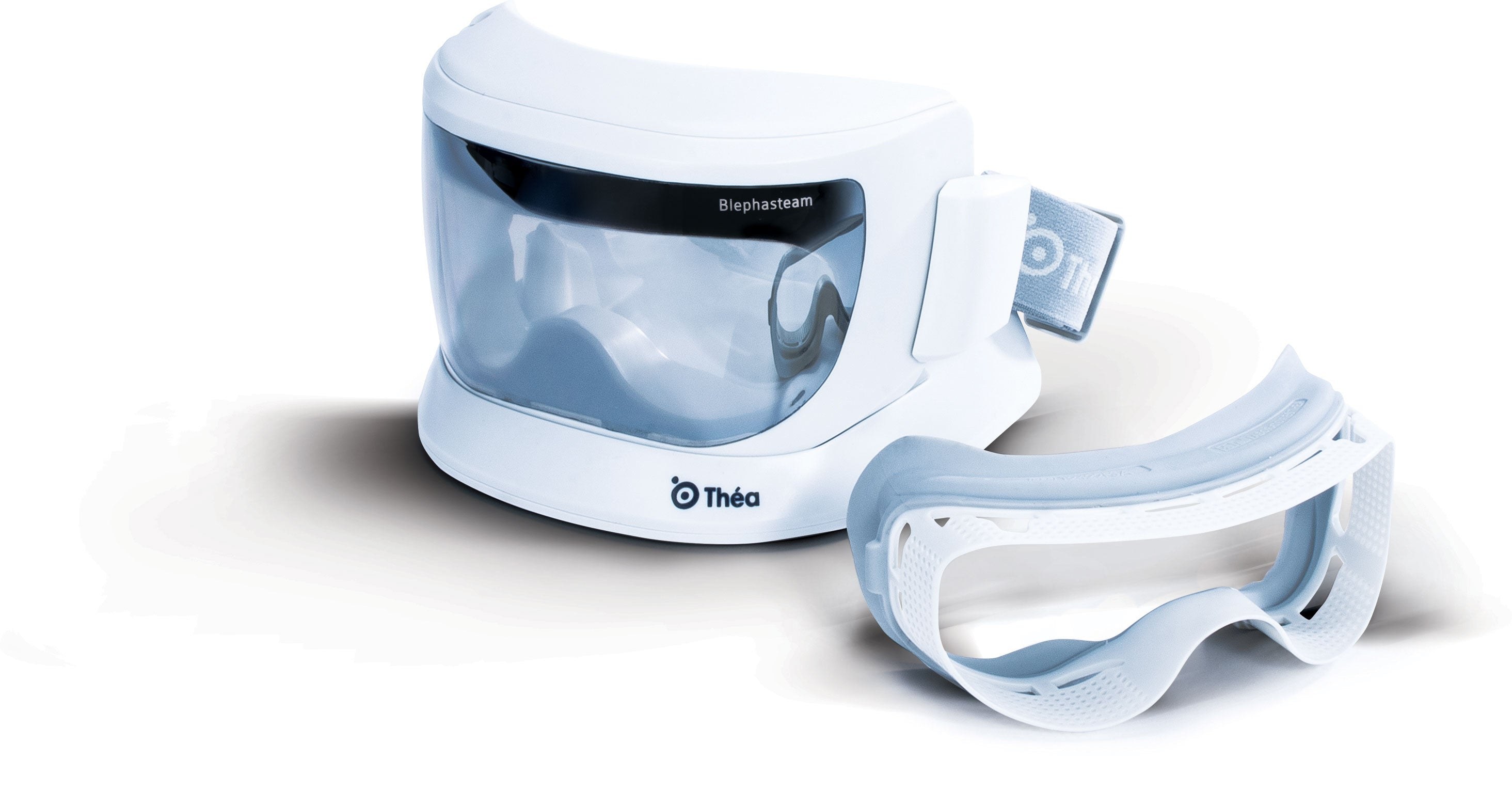
Blephasteam is a pair of heated goggles that bathe the closed eyelids in warm, moist air at a controlled temperature. It is one of the simplest and gentlest thermal treatments for meibomian gland dysfunction (MGD) and it is available at Rose Optometry in Frankton, Hamilton, both as an in-clinic treatment and, where prescribed, as guided home therapy.
Book a Dry Eye Evaluation online: open our online booking — the Dry Eye Evaluation is preselected; just choose a time. This is a paid, in-depth assessment (TearCheck, meibography and ScoutPro osmolarity) and the fee is confirmed when you book. Prefer to talk? Call (07) 847 3195.
Why heat matters in dry eye
The oil made by the meibomian glands should flow like olive oil. In MGD it thickens towards the consistency of butter, blocks the gland openings and stops reaching the tear film. Without that oily layer tears evaporate quickly and the eye feels gritty, tired and blurry, especially at the end of the day. Drops top up water; they do not replace oil. Heat softens the oil so it can be released, which is why warm compresses are the first thing every dry-eye clinician suggests. Our article on meibomian gland dysfunction covers the background.
The trouble with a flannel or a microwaved mask is consistency. It is too hot, then too cool, and it dries out within a couple of minutes. Laboratory work on warm compresses suggests the inner eyelid needs to reach and hold a therapeutic temperature for several minutes for the oil to soften properly, and that most home methods struggle to do this.
How Blephasteam works
Blephasteam goggles hold a small moistened ring inside each eyecup and warm the chamber to a controlled temperature. The moist heat is designed to keep the lid temperature stable for the full session and, because the eyes are enclosed in a humid chamber, to protect the ocular surface from drying out while the lids warm. Sessions run for about ten minutes with your eyes open or closed. There are no wires touching the eyes and no pressure on the globe.
What a session involves
In clinic, you sit comfortably wearing the goggles for ten minutes while the meibum softens. Immediately afterwards your optometrist expresses the glands at the slit lamp, pressing gently along the lid margin to clear the softened oil. This is the important step: heat without expression is incomplete. Softened oil that is not released simply cools and re-blocks. Where we prescribe Blephasteam for home use, we set the routine, show you how to follow it with gentle lid massage, and check the glands at review so we can see whether the routine is doing its job.
Where Blephasteam fits
- Gentle first-line thermal treatment. For mild to moderate MGD, or for people who are not yet ready for, or not suited to, IPL or LipiFlow.
- Preparation. Softening the glands before expression, or before another procedure, so the treatment achieves more.
- Alongside IPL or LipiFlow. Regular warm therapy between sessions keeps the glands flowing and helps the results last.
- Maintenance. After a course of treatment, to hold the ground gained.
- Sensitive patients. Those with sensitive lid skin, contact-lens wearers, or people who find dry heat uncomfortable.
Honest limits
Blephasteam is a heat delivery system. It softens oil; it does not remove inflammation, treat Demodex, or unblock glands on its own. If glands have already atrophied, no amount of heat brings them back, which is why meibography before treatment matters and why we say act early. Its evidence base is modest: a small randomised trial and an open-label French study reported better symptom relief than a warm towel and improved meibum quality, though objective tear-film measures did not change much. It is best seen as a component of a programme rather than a cure. Patients with more advanced or inflammatory disease usually need LipiFlow, IPL or a Demodex programme with BlephEx as well.
The assessment decides the treatment
Every treatment starts with an assessment at our Dry Eye Clinic in Hamilton, where TearCheck, meibography and ScoutPro osmolarity tell us whether your dry eye is oil, water, lids or Demodex, and how far along it is. Waikato patients have been driving to Auckland for structured dry-eye care; it is now available here for Hamilton, Cambridge, Te Awamutu, Morrinsville, Huntly and Raglan, and assessment is also offered at our affiliated practice, Visique Rototuna Optometrists. Heat masks, warm compresses, lid cleansers and preservative-free drops for home use are in our online store, with free NZ shipping over $100. Rose Optometry is a member of the Dry Eye Specialist Group.
Optometrists for Blephasteam at Rose Optometry
You will be seen by one of seven therapeutically qualified optometrists — all University of Auckland graduates, all able to prescribe eye medication where it is needed, and all of whom examine patients from six weeks of age.
- Jagrut Lallu — Partner Optometrist · BOptom (Hons), MSc Specialty Lenses (Hons), FIAOMC. Prescribes Blephasteam treatment for eyelid gland disease; Blephasteam is one of Jagrut's special interests. All special interests: children's vision, myopia management, orthokeratology, keratoconus and scleral lenses, dry eye.
- Jacqueline Rowe — Partner Optometrist · BSc, BOptom. Prescribes Blephasteam treatment for eyelid gland disease; Blephasteam is one of Jacqueline's special interests. All special interests: dry eye and meibomian gland dysfunction, orthokeratology, keratoconus, children's vision.
- Emilie Lawson — BOptom (Hons) · Accredited Glaucoma Prescriber · ACO Certificate in Advanced Contact Lenses. Prescribes Blephasteam treatment for eyelid gland disease; Blephasteam is one of Emilie's special interests. All special interests: children's vision, myopia management, orthokeratology, glaucoma, keratoconus, dry eye.
- Jason Shen — BOptom (Hons). Prescribes Blephasteam treatment for eyelid gland disease. Special interests: keratoconus and specialty contact lenses, children's vision.
- Jessica Wood — BOptom (Hons) · Clinical Research Optometrist, New Zealand Eye Research Centre. Prescribes Blephasteam treatment for eyelid gland disease; Blephasteam is one of Jessica's special interests. All special interests: orthokeratology, keratoconus, dry eye, children's vision, clinical research.
- Stella Wong — BOptom (Hons). Prescribes Blephasteam treatment for eyelid gland disease; Blephasteam is one of Stella's special interests. All special interests: myopia management, orthokeratology, keratoconus and specialty contact lenses, binocular vision, dry eye, children's vision.
- Anjali Hira — BOptom (Hons). Prescribes Blephasteam treatment for eyelid gland disease; Blephasteam is one of Anjali's special interests. All special interests: children's vision, orthokeratology, keratoconus, dry eye.
Frequently asked questions
Does it hurt?
No. Most people find it soothing. The gland expression afterwards may feel slightly uncomfortable for a minute or two.
How often is it done?
In clinic, as part of a treatment visit or review. At home, typically daily or several times a week for a set period, then reduced to maintenance. Your optometrist sets the schedule based on your gland images.
Is Blephasteam better than a heat mask?
It holds a more even, moist temperature for the full session. A good reusable heat mask from the store is still a reasonable option for many people, and we will tell you which is right for you.
How do I start?
Call (07) 847 3195 or email info@roseoptom.co.nz to book a dry-eye assessment at Rose Optometry, 38 Lake Road, Frankton, Hamilton, or book a Dry Eye Evaluation online (the appointment is preselected).
Is Blephasteam any good compared with a hot flannel or heat mask?
The advantage is control: it holds a constant, safe temperature and humidity around both eyes for ten minutes with the eyes open, which a flannel cannot do and a microwave mask does only for the first couple of minutes. It is a supervised in-clinic warming step before gland expression, not a replacement for a daily home heat routine.
How much does Blephasteam treatment cost in Hamilton?
We quote plainly at assessment. Blephasteam sessions are usually part of a broader dry-eye plan rather than a standalone purchase, so the cost depends on what your assessment shows you need. Call (07) 847 3195.
Can I buy Blephasteam goggles for home use?
Ask us at your assessment. We can advise on a home Blephasteam unit where it suits you, and our online store stocks the reusable heat masks we recommend for daily use.
Questions we are asked about Blephasteam
What is Blephasteam used for?
It is a moist-heat goggle device that holds the eyelids at a controlled temperature and humidity for a set period, softening hardened oil so the glands can be expressed. The point of it is control: reaching and holding the temperature at which blocked meibum liquefies, which a face cloth cannot do.
Is Blephasteam worth it?
As a maintenance and preparation tool, for the right patient, yes. It is gentler and lower-cost than the in-clinic mechanical treatments, and it suits people who need consistent, controlled warming rather than a one-off procedure. It is generally not sufficient on its own for advanced, hardened obstruction — heat without effective expression achieves little. We will tell you honestly which category you are in after the evaluation.
What is the most successful treatment for dry eyes?
The one matched to your diagnosis. Blocked glands, inflamed rosacea-type lids, lid-margin debris and aqueous deficiency each respond to different things, and most people have a combination. That is the case for measuring first — see our dry eye clinic page.
Book in Hamilton
Start with a Dry Eye Evaluation.
Rose Optometry, 38 Lake Road, Frankton, Hamilton. 07 847 3195
References
- Sim HS, Petznick A, Barbier S, et al. A Randomized, Controlled Treatment Trial of Eyelid-Warming Therapies in Meibomian Gland Dysfunction. Ophthalmol Ther. 2014;3(1-2):37-48. PMID 25156975. doi:10.1007/s40123-014-0025-8
- Doan S, Chiambaretta F, Baudouin C; ESPOIR study group. Evaluation of an eyelid warming device (Blephasteam) for the management of ocular surface diseases in France: the ESPOIR study. J Fr Ophtalmol. 2014;37(10):763-772. PMID 25282620. doi:10.1016/j.jfo.2014.06.004
- Purslow C. Evaluation of the ocular tolerance of a novel eyelid-warming device used for meibomian gland dysfunction. Cont Lens Anterior Eye. 2013;36(5):226-231. PMID 23566749. doi:10.1016/j.clae.2013.02.009
- Blackie CA, Solomon JD, Greiner JV, Holmes M, Korb DR. Inner eyelid surface temperature as a function of warm compress methodology. Optom Vis Sci. 2008;85(8):675-683. PMID 18677234. doi:10.1097/OPX.0b013e318181adef
- Jones L, Craig JP, Markoulli M, et al. TFOS DEWS III: Management and Therapy. Am J Ophthalmol. 2025;279:289-386. PMID 40467022. doi:10.1016/j.ajo.2025.05.039
Frequently asked questions
At Rose, a standard adult eye examination is $129. A new patient appointment takes 45 minutes, and imaging and a full pre-examination workup are included in that price rather than added afterwards. Children and school students are $79, tertiary students $99, and an acute appointment for a sudden problem — a red eye, a foreign body, a sudden change in vision — is $69. Where further testing is needed it is quoted before it is done: visual fields $69, macular OCT $69, full OCT $194, anterior segment OCT $39, corneal topography $59, optical biometry $49, cycloplegic refraction $59. Specialist appointments are priced separately. A keratoconus consultation is $139 for 30 minutes or $169 for 45. An ortho-k consultation is $129. A full dry eye evaluation, which produces a written treatment plan, is $247 — it assumes a current full eye examination, either with us ($129) or a full examination record from another practice within the last six months. Fees elsewhere in New Zealand vary widely, and a lower advertised price usually means a shorter appointment with imaging charged as an extra or not offered at all. It is worth comparing what is included rather than the headline number. Ring us on 07 847 3195 if you want the fee for your situation confirmed before you book.
No practice can honestly claim that, and you should be wary of any that does — "best" depends entirely on what your eyes need. If your eyes are straightforward, several good practices in Hamilton will look after you well, and we would rather say that than pretend otherwise. What separates practices is what they can measure, and what they can treat when things are not straightforward. Rose was built around the complicated end. The Rose K lens for keratoconus was designed in this practice, and lenses of that family are, on the manufacturer's figures, among the most widely prescribed in the world for the irregular cornea. We hold swept-source OCT, corneal tomography, epithelial thickness mapping, two independent optical biometers for monitoring a child's short-sightedness, and objective tear film assessment. For dry eye we hold intense regulated pulsed light, LipiFlow, Blephasteam, Tixel and Rexon-Eye — to the best of our knowledge no other practice in New Zealand has all of these under one roof. A better question than "who is best" is "who is set up for what I have". Ask any practice you are considering how long the appointment is, what they can measure, and whether imaging is included or extra. Those answers will tell you more than a ranking would.
Not usually as a full examination, but there are genuinely free and subsidised pathways worth knowing about. Pre-school children are screened free through the B4 School Check, and there is vision screening in schools. Both are screenings rather than eye examinations — they are designed to catch obvious reduced vision and they miss a great deal, including focusing problems and early short-sightedness. A child who passes a screening can still need glasses. Children under 16 whose family holds a Community Services Card, or who hold a current High Use Health Card, may be eligible for the government spectacle subsidy towards an examination and glasses. MSD criteria apply, and we accept MSD and WINZ payment cards. Southern Cross members can use their optical benefits with us, and we offer Afterpay, Genoapay, QCard and GoCardless. We also run two free 15-minute chats. The myopia chat is for parents of a short-sighted child who want the options explained and want help deciding what is actually right for their family, with our experience behind that decision rather than a brochure. The ortho-k chat is for anyone considering overnight lenses who wants to understand what is involved before committing. Neither is an eye examination, but both are a proper conversation with someone who does this work. If cost is the reason you have been putting off having your eyes checked, ring us on 07 847 3195 and say so. We would rather find a way than have you not come.
While payment is generally required on the day of appointment, we do offer a number of payment options including Afterpay, Genoapay, QCard, and GoCardless.
Yes, we do.
Yes, you can.
Yes, if you are under 16 years of age you may be eligible for a subsidy for glasses. MSD criteria apply.
No. We are closed on public holidays and long weekends as we believe our staff should have the chance to enjoy this time with friends and family.
If your eyes are straightforward, almost any good optometrist can look after you well, and we would rather say that than pretend otherwise. Come to us when something is not straightforward: a prescription that will not settle, a cornea that has changed shape, a child whose short-sightedness is moving faster than it should, an eye surface that has stopped being comfortable, or a diagnosis you have been given but do not understand. Those problems are decided by measurement, and measuring them properly needs instruments most practices do not have.
Yes, and you do not need to justify it. A second opinion is not a criticism of whoever saw you first — very often they were right, and what you actually needed was the finding explained and the numbers put in front of you. What we can add is measurement. We can image the layers of your cornea and retina, map the epithelium, quantify how far your cornea sits from normal, measure the length of your eye and check your tear film objectively. That turns “something is not right” into a number, and a number either explains the problem or rules it out. Bring any previous scans, prescriptions and letters. Comparison against your own past results is often the most valuable thing in the room.
Usually. Complex is what this practice was built around — keratoconus, corneal grafts, irregular corneas after surgery or injury, severe dry eye, high prescriptions, and eyes that have been told they are not fittable with contact lenses. The Rose K lens for keratoconus was designed in this practice, and lenses of that family are, on the manufacturer's figures, among the most widely prescribed in the world for the irregular cornea. If we cannot help, we will tell you at the first appointment and tell you who can, rather than taking you through a course of treatment that was never going to work.
Not necessarily. “Not fittable” usually means not fittable with the lens designs and the measurements available at the time. Corneal mapping, epithelial thickness imaging and modern scleral and custom lens designs have moved a long way, and eyes that were genuinely unfittable ten years ago are often routine now. What we can promise is an honest answer after we have measured, not before.
Measure things that are usually not measured. Swept-source OCT of the cornea gives us tomography, full-thickness mapping, epithelial thickness mapping and an objective ectasia risk score. Retinal OCT with autofluorescence shows cellular-level change without any dye being injected. Optical biometry measures the length of the eye to a hundredth of a millimetre, which is how myopia is properly monitored. Objective tear film assessment and osmolarity replace guessing about dry eye. Most of these produce a baseline you can be compared against for the rest of your life, and that comparison is frequently worth more than any single result.
No. Anyone can book directly. Many of our patients are referred by their own optometrist, their GP or an ophthalmologist, and just as many simply ring us. A referral letter is useful because it saves repeating history, but it is not a requirement and it is not a condition of being seen.
No, and we would not build a referral practice on that basis. We accept referrals every week from optometrists across the Waikato and well beyond — Specsavers, OPSM, Bailey Nelson, Visique, For Eyes and independent practices alike. The patient comes to us for the part that needs our instruments or our lens work, and goes back to you with a written plan and the imaging. We are also glad to talk a case through before you refer, and if you have an OCT but no biometer we can help you get objective myopia measures out of the instrument you already own. Please contact us for co-management.
Waiting is the one thing that cannot be undone. Short-sightedness is axial — the eye is physically growing too long — and that length does not come back. What treatment does is slow the rate of growth, so the earlier it starts the more length is saved. We measure axial length directly on two independent biometers and plot it against normal growth curves, which means we can see a child drifting off their expected curve before the prescription changes. There is a free 15-minute myopia chat if you want to understand the options before committing to anything. It is worth being precise about what we are all trying to achieve. Myopia control does not stop a child's eyes changing and no practice should tell a parent it will. What it does, reliably and across many published trials, is slow the rate at which the eye lengthens — and because the risk of retinal detachment, myopic maculopathy and glaucoma in later life rises with every extra millimetre, slowing that growth is how a child is kept out of the range where sight is genuinely at risk. After seventeen years of focusing on this, we are now seeing children on customised plans whose axial length is not progressing at all over a monitoring period, and in some cases measurements that come back slightly shorter than the ones before them. That is our own clinical observation in our own patients rather than a trial result, and it has to be read carefully, because the choroid thickens when treatment is working and part of an apparent reduction can be that thickening rather than the eye itself shortening. That is precisely why we measure both. We are not yet able to tell a parent that we can stop myopia in its tracks, and we will not say it until we can.
Two things: we measure it before treating it, and we hold every current treatment technology in one building. Most dry eye is treated on the basis of symptoms, which is why drops so often fail. A tear film can be failing because the oil layer is blocked, because the water layer is short, because the surface is inflamed, or because the lids are the problem, and those need different treatments. We assess the tear film objectively with TearCheck — tear film stability, the oil layer, lid and gland imaging, and an inflammation measure — and measure tear osmolarity, the saltiness of the tears, which is the closest thing to a laboratory number for dry eye. Then we treat the cause. Rose holds intense regulated pulsed light for inflammation and gland function, LipiFlow thermal pulsation to clear blocked meibomian glands from the inner lid surface, Blephasteam controlled-humidity warming, Tixel thermomechanical treatment for the lids, and Rexon-Eye quantum molecular resonance for the more severe and treatment-resistant cases. At the time of writing, and to the best of our knowledge, no other optometrist or ophthalmologist in New Zealand has all of these available under one roof. We say that as a statement of fact rather than a boast, and we would be glad for it to stop being true. Dry eye is one of the most common and most under-treated conditions we see, and there are far more people living with it than one practice can look after. Any practice wanting to build this kind of service has our encouragement and our help — please contact us for co-management, and send us the cases you are not yet set up for. Why holding all of them matters is simple. A practice with one dry eye machine will offer you that machine. Holding all of them means the assessment decides the treatment, rather than the equipment deciding it — and when the first approach does not work, the next one is in the next room rather than in another city.
Yes — from around six weeks of age. Babies and toddlers are tested with Cardiff acuity cards and retinoscopy, neither of which needs the child to read a letter, name a picture or say a word. Most of the findings that matter in a young child cause no symptoms and are invisible to a parent, which is exactly why they need looking for.
There is one good reason: a baseline. Almost everything we look for — glaucoma, macular change, a cornea beginning to alter shape, an eye that is lengthening — is diagnosed by comparison over time rather than by a single reading. A scan taken while everything is normal is the reference every future scan is measured against, and it is the one you cannot go back and take later.
Because measurement takes time and we would rather not split it across visits. A first appointment usually involves imaging as well as examination, and you should expect to have the results shown to you and explained rather than summarised. If a problem is genuinely straightforward we will say so and keep it short.
In NZ an optometrist can calculate the prescription for glasses, fit contact lenses, diagnose and treat eye conditions and infections with medication. They can also manage ocular injuries including removing foreign objects. If surgery or specialist treatment is required they can refer to an ophthalmologist (eye surgeon), hospital, or other health care specialist. NZ-trained optometrists must complete a 5-year degree at the University of Auckland before becoming registered.
A dispensing optician has formal training in optical dispensing. They are qualified to help a client choose frames, read a prescription, discuss lens options, take measurements, order and fit glasses.
An ophthalmologist is a medical doctor who has specialised in the treatment of serious eye disease and ocular surgery such as cataract removal. They do not typically prescribe glasses or contact lenses.
Not always, and the difference is usually time and instruments rather than the optometrist. A low advertised fee generally buys a shorter appointment aimed at producing a spectacle prescription. That is a legitimate service and for many people it is enough. What it often does not include is retinal imaging, OCT scanning of the optic nerve and macula, measurement of eye length, or objective assessment of the tear film — the tests that find glaucoma before you notice it, detect macular change early, monitor a child's short-sightedness properly, or explain why your eyes feel gritty. At Rose a new patient appointment is 45 minutes, and imaging and the full pre-examination workup sit inside the $129 rather than on top of it. We are not the cheapest and do not try to be. Whichever practice you choose, three questions are worth asking: how long is the appointment, is imaging included or charged separately, and what happens to the images afterwards. A scan that is taken and kept becomes the baseline every future scan is compared against, and that comparison is frequently worth more than any single result.
Start with an optometrist in almost every case. An optometrist is your first point of contact for eye health and vision — examining the eyes, prescribing glasses and contact lenses, diagnosing eye disease, and in New Zealand treating many conditions with prescription medicines. An ophthalmologist is a medical doctor and eye surgeon who treats serious disease and performs surgery such as cataract removal, and who does not usually prescribe glasses or contact lenses. Neither is better than the other; they do different jobs. Most eye problems are diagnosed and managed by an optometrist, and where surgery or specialist medical treatment is needed we refer you promptly and stay involved in your care. The exception is anything sudden and severe: sudden loss of vision, a curtain across your vision, severe eye pain with a red eye, or a shower of new floaters and flashes. Phone us on 07 847 3195 rather than booking online — a person, not a calendar, decides how quickly you are seen — or go to hospital.
We are at 38 Lake Road in Frankton, with parking on site, a few minutes from the city centre and straightforward to reach from the western side of Hamilton. Our patients come from right across the city — Frankton, Dinsdale, Nawton, Te Rapa, Glenview, Hamilton East, Hillcrest, Chartwell, Rototuna and the central city — and from across the wider Waikato, including Cambridge, Te Awamutu, Morrinsville, Matamata, Huntly, Ngaruawahia, Otorohanga and Raglan. Because much of what we do is specialist work, a good number travel considerably further. We regularly see patients from Auckland, Tauranga, Rotorua, Taupo, Taranaki and the lower North Island for keratoconus, scleral and custom contact lens fitting, and complex dry eye — and we see patients from overseas who combine treatment with a trip. If you are travelling a distance, tell us when you book and we will group your appointments so the journey is worth making.
Forty-five minutes for a new patient, and the appointment is built so the measuring is done before you sit down with the optometrist. A full pre-examination workup and imaging are included in the fee rather than charged on top: assessment of your vision and prescription, examination of the front and back of the eye, eye pressure, and retinal imaging that becomes your permanent baseline. You will leave knowing what we found, what it means, and what — if anything — needs doing. If the honest answer is that nothing needs doing, that is what you will hear. If something needs watching or treating, you get a clear plan and a review date. Where a specific problem needs a specific test — visual fields, OCT, corneal topography, eye length measurement — those are quoted to you before they are done, never added afterwards without your agreement. Existing patients returning for a routine examination are booked for 30 minutes. Please arrive ten minutes early, and bring your current glasses or contact lenses, any recent prescription or referral letter, and a note of the medications you take, because some affect the eyes.
See things the Rose way
Make an appointment at Hamilton’s leading eye care specialists.

