Ortho-K: glasses-free days and slower myopia, from a lens you wear overnight
Imagine your child taking a lens out each morning and seeing clearly all day — no glasses for school, no lenses for sport or swimming — while the treatment quietly works to slow their short-sightedness getting worse. That is orthokeratology, or ortho-K (we call it Shift at Rose), and it is one of the specialty areas our practice has worked in for decades.
What ortho-K actually is
Ortho-K uses a custom-designed rigid lens worn only while sleeping. Overnight, it gently and reversibly reshapes the very front surface of the cornea. In the morning the lens comes out and the reshaped cornea focuses light correctly on its own — so your child sees clearly through the day with nothing in their eye. Stop wearing the lenses and the cornea returns to its original shape within days; nothing permanent is done.
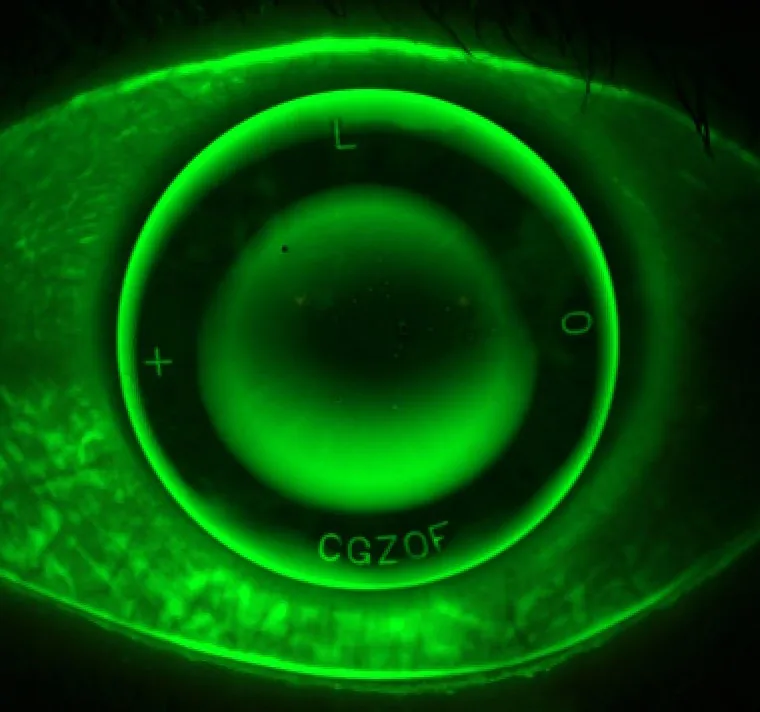
The picture above is an ortho-K fit
That green image is a real fluorescein photograph of an ortho-K lens on the eye — a stain we use to see how the lens sits. The bright concentric rings show exactly where the lens is gently redistributing the corneal surface to create a central treatment zone. Reading these patterns precisely is the craft of a good ortho-K fit, and it is why fitting is done with corneal mapping and careful review rather than off a standard prescription.
Two benefits in one lens
Ortho-K does two useful things at once. First, it gives clear, correction-free daytime vision — a real advantage for children in sport, swimming or dusty environments, and for anyone who would rather not wear glasses or daytime contacts. Second, and increasingly the reason families choose it, ortho-K is one of the evidence-based options for slowing the progression of childhood myopia.
What the evidence shows
In the two-year Retardation of Myopia in Orthokeratology (ROMIO) randomised controlled trial, children aged 6–10 who wore ortho-K lenses had about 43% less axial eye growth than children in single-vision glasses, with the effect strongest in younger, faster-progressing children (Cho & Cheung, Investigative Ophthalmology & Visual Science, 2012). Slower axial growth matters because longer eyes carry higher lifetime risk of conditions such as retinal detachment and myopic maculopathy. As with every myopia treatment, ortho-K slows progression rather than stopping it, and results vary from child to child — we will always be honest with you about that.
Is it safe, and is it for us?
Ortho-K has a good safety record when lenses are properly fitted and hygiene is followed, and the trial above recorded its adverse events transparently — which is exactly why fitting, teaching and regular review matter. Whether ortho-K is the right choice depends on your child's prescription, eye shape, age and lifestyle, and how your family feels about a nightly lens routine. It is one of several good options; our job is to help you choose honestly among them. You can read our overview of the myopia-control evidence for how ortho-K compares with soft dual-focus lenses and atropine drops.
How to start in Hamilton
The best first step is an unhurried conversation. Our free Shift / Ortho-K chat with Jagrut Lallu is a no-cost, no-obligation 15 minutes to look at whether ortho-K suits your child and answer your questions. Book a free Shift / Ortho-K chat, or read more about ortho-K (Shift) lenses and myopia control at Rose Optometry, Hamilton.
References & key studies
Cho P, Cheung SW. Retardation of Myopia in Orthokeratology (ROMIO) Study: A 2-Year Randomized Clinical Trial. Investigative Ophthalmology & Visual Science. 2012;53(11):7077-7085. PMID: 22969068.
Hiraoka T. Myopia Control With Orthokeratology: A Review. Eye & Contact Lens. 2022;48(3):100-104. PMID: 34860723. Across published studies, the 2-year effect on axial elongation ranges from 32% to 63% compared with single-vision glasses or contact lenses — the ROMIO figure above sits within this range.
Swarbrick HA, Alharbi A, Watt K, et al. Myopia Control During Orthokeratology Lens Wear in Children Using a Novel Study Design. Ophthalmology. 2015;122(3):620-630. PMID: 25439432. In this small (n=26), older contralateral-eye crossover study, the ortho-K-wearing eye showed no measurable axial growth over 12 months while the fellow eye wearing a daytime rigid gas-permeable lens grew significantly — a striking result the authors themselves bound to the “initial months” of wear, attributed partly to corneal thinning and choroidal thickening rather than growth arrest alone, and note used a rigid daytime lens (not spectacles) as the comparator.
Note: myopia-control figures for ortho-K are always given as axial length change, never as a change in glasses prescription — because ortho-K deliberately reshapes the cornea to correct vision, so refraction cannot be used to judge whether the underlying eye growth is slowing.
References & key studies
Cho P, Cheung SW. Retardation of Myopia in Orthokeratology (ROMIO) Study: A 2-Year Randomized Clinical Trial. Investigative Ophthalmology & Visual Science. 2012;53(11):7077-7085. PMID: 22969068.
Hiraoka T. Myopia Control With Orthokeratology: A Review. Eye & Contact Lens. 2022;48(3):100-104. PMID: 34860723. Across published studies, the 2-year effect on axial elongation ranges from 32% to 63% compared with single-vision glasses or contact lenses — the ROMIO figure above sits within this range.
Swarbrick HA, Alharbi A, Watt K, et al. Myopia Control During Orthokeratology Lens Wear in Children Using a Novel Study Design. Ophthalmology. 2015;122(3):620-630. PMID: 25439432.
Common questions about ortho-K lenses
Are ortho-K lenses available if I don't live in Hamilton? Ortho-K (Shift) lens fitting at Rose Optometry is available to patients travelling from across the Waikato and wider New Zealand; fitting requires corneal mapping, so an in-person assessment is needed before lenses are ordered.
How much do ortho-K lenses cost in NZ? Cost depends on prescription complexity and the review schedule required; your optometrist will give you a written quote at your free Shift / Ortho-K chat.
Is Rose Optometry involved in myopia research? Yes — through our affiliation with the New Zealand Eye Research Centre (NZERC), founded by Jagrut Lallu, our optometrists contribute to ongoing myopia management research and apply current evidence directly in clinic.
Note: myopia-control figures for ortho-K are always given as axial length change, never as a change in glasses prescription — because ortho-K deliberately reshapes the cornea to correct vision, so refraction cannot be used to judge whether the underlying eye growth is slowing.




See things the Rose way
Make an appointment at Hamilton’s leading eye care specialists.

