Recurrent corneal erosion: why a healed scratch can keep tearing open — and how we treat it
You scratched your eye weeks ago — a fingernail, a branch, the corner of a page — and it healed. Then one morning you open your eyes and the pain is back, sharp and sudden, with watering and light sensitivity, as if the injury just happened again. That is the hallmark of recurrent corneal erosion (RCE), and it is one of the more common — and more treatable — corneal conditions we manage at Rose Optometry.
What is actually going on
The cornea's outer skin (the epithelium) normally grips the layer beneath it through a fine anchoring structure called the basement membrane. After certain injuries — or in people with a naturally weaker basement membrane (epithelial basement membrane dystrophy) — the new skin grows back but doesn't anchor properly. Overnight, the eye surface dries slightly and the lid can stick to that loose patch; the first blink in the morning tears it away. Hence the classic pattern: severe pain on waking, watering, grittiness, light sensitivity and blurred vision, settling over hours or days, then returning without warning.
What healing really looks like
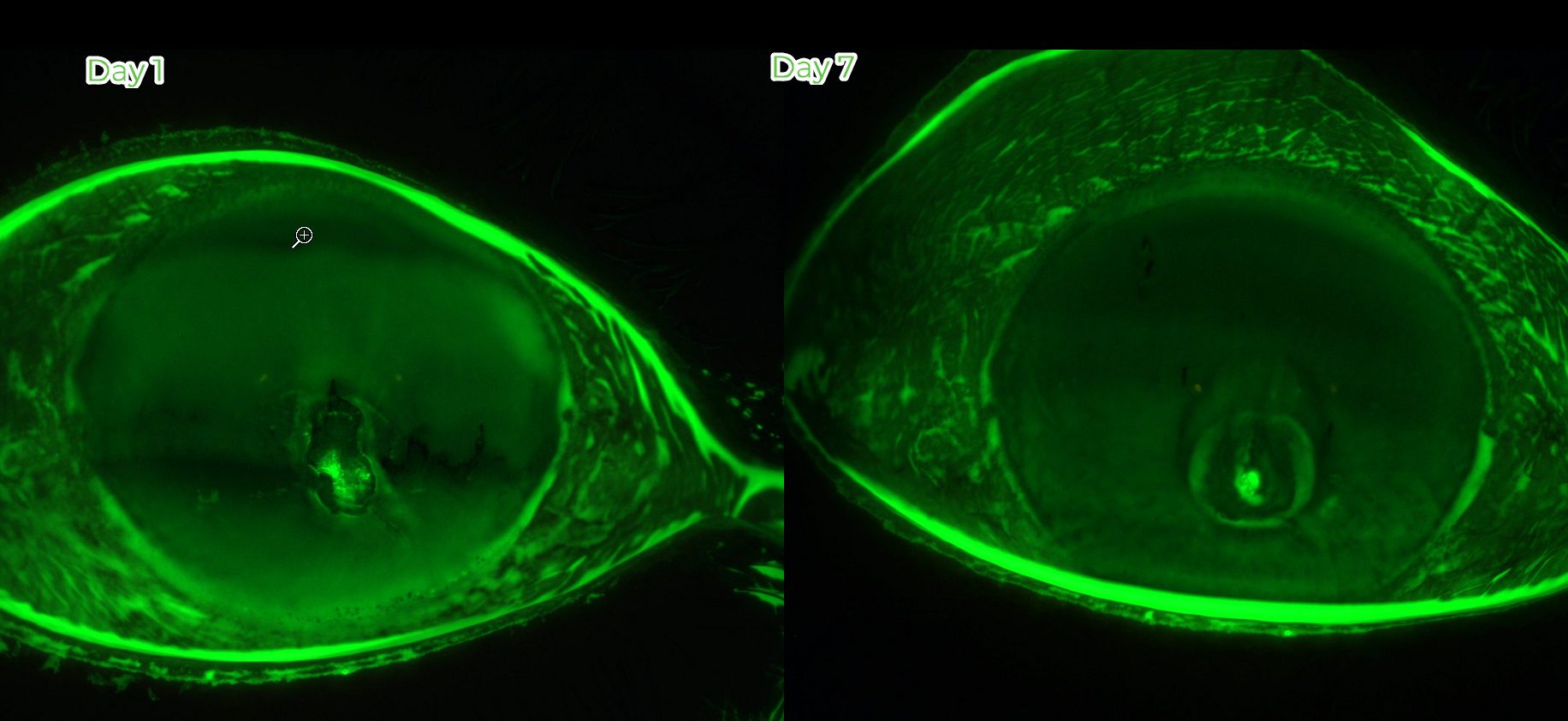
The image above and the one below are clinical photographs from our slit lamp, taken over 38 days of treatment. The yellow-green dye (fluorescein) glows wherever the surface is broken. On Day 1 the bright central patch is loose, broken epithelium; by Day 7 the defect has largely closed under a bandage contact lens.
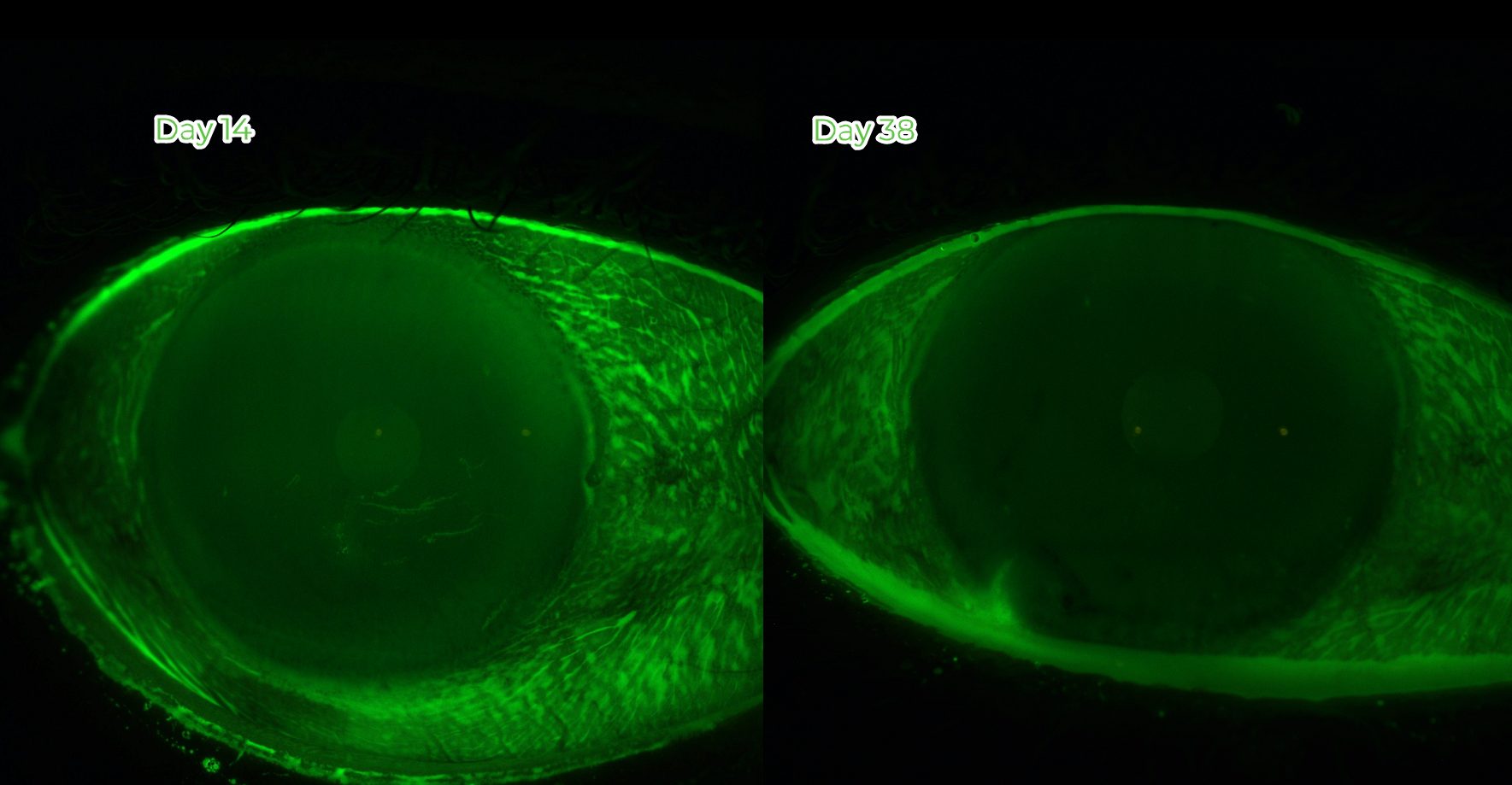
By Day 14 and Day 38 the surface is closed and progressively smoother. Crucially, the eye can feel normal from about this point while the anchoring layer underneath is still re-forming — which is exactly why treatment continues after the pain stops. The surface skin can close within days, but the "glue" that anchors it takes roughly two to three months to mature. Stopping night-time treatment the week you feel better is the single most common reason erosions come back.
How we treat it at Rose Optometry
Treatment is staged to the severity and frequency of your episodes. Intensive lubrication: preservative-free artificial tears by day, and a lubricating or hypertonic saline (5% sodium chloride) ointment at bedtime — the night ointment stops the lid sticking to the healing surface, and usually continues for three to six months. A bandage contact lens for painful episodes protects the loose epithelium from the blink and relieves pain quickly. Treating the tear film, because dry eye and lid-margin disease make erosions more likely. And in stubborn cases, a course of low-dose oral doxycycline with anti-inflammatory drops — the tablet is not treating infection; at low dose it calms the tear-film enzymes that dissolve the new anchoring complexes. As therapeutically qualified optometrists we prescribe and manage all of this in-practice, with slit-lamp photography to track your healing objectively.
If it keeps coming back: laser treatment (PTK)
A minority of eyes continue to break down despite months of good treatment. For these, the next step is phototherapeutic keratectomy (PTK) — a brief outpatient laser procedure in which an ophthalmologist removes the faulty surface layer and lightly polishes the anchoring zone so fresh epithelium can bond properly. For most people PTK substantially reduces the chance of further erosions, though no procedure can guarantee an eye will never erode again. If your erosions recur despite treatment, we refer you directly — with your imaging and treatment history attached — to one of two Hamilton practices: the Laser Eye Centre (22 Thackeray Street, 0800 733 2020, surgeons Drs Bheema Patil, Michael Merriman, Benjamin Hoy and Malcolm Carey) or Hamilton Eye Clinic (Bridgewater Building, 130 Grantham Street, 07 834 0006). We continue your aftercare together with the surgical team.
Sore eye right now?
Sudden severe eye pain, pain on waking, light sensitivity or reduced vision should be assessed the same day. Ring us on 07 847 3195 and we will fit you in, or book an acute appointment (new patient) / acute appointment (existing patient).
Frequently asked questions
What causes recurrent corneal erosion?
Most cases follow a sharp scratch — a fingernail, paper edge, plant or mascara wand — that damages the cornea's anchoring layer, so the healed surface never grips properly. Some people instead have epithelial basement membrane dystrophy, an inherited weakness of that layer, and erosions can appear without any remembered injury.
How long does recurrent corneal erosion last?
An individual episode usually settles over hours to a few days, but the underlying weakness lasts longer: the anchoring complexes take roughly two to three months to mature, which is why night-time treatment typically continues for three to six months even after the eye feels normal.
Can recurrent corneal erosion be cured?
Most people settle completely with consistent treatment carried through the full healing window. For the minority who keep eroding, PTK laser treatment substantially reduces the chance of further episodes for most people.
Is recurrent corneal erosion serious?
It is intensely painful rather than usually sight-threatening, but any open corneal surface carries an infection risk — so it deserves proper assessment and treatment rather than waiting it out.



See things the Rose way
Make an appointment at Hamilton’s leading eye care specialists.

