Red Light Therapy: A New Frontier in Myopia Management
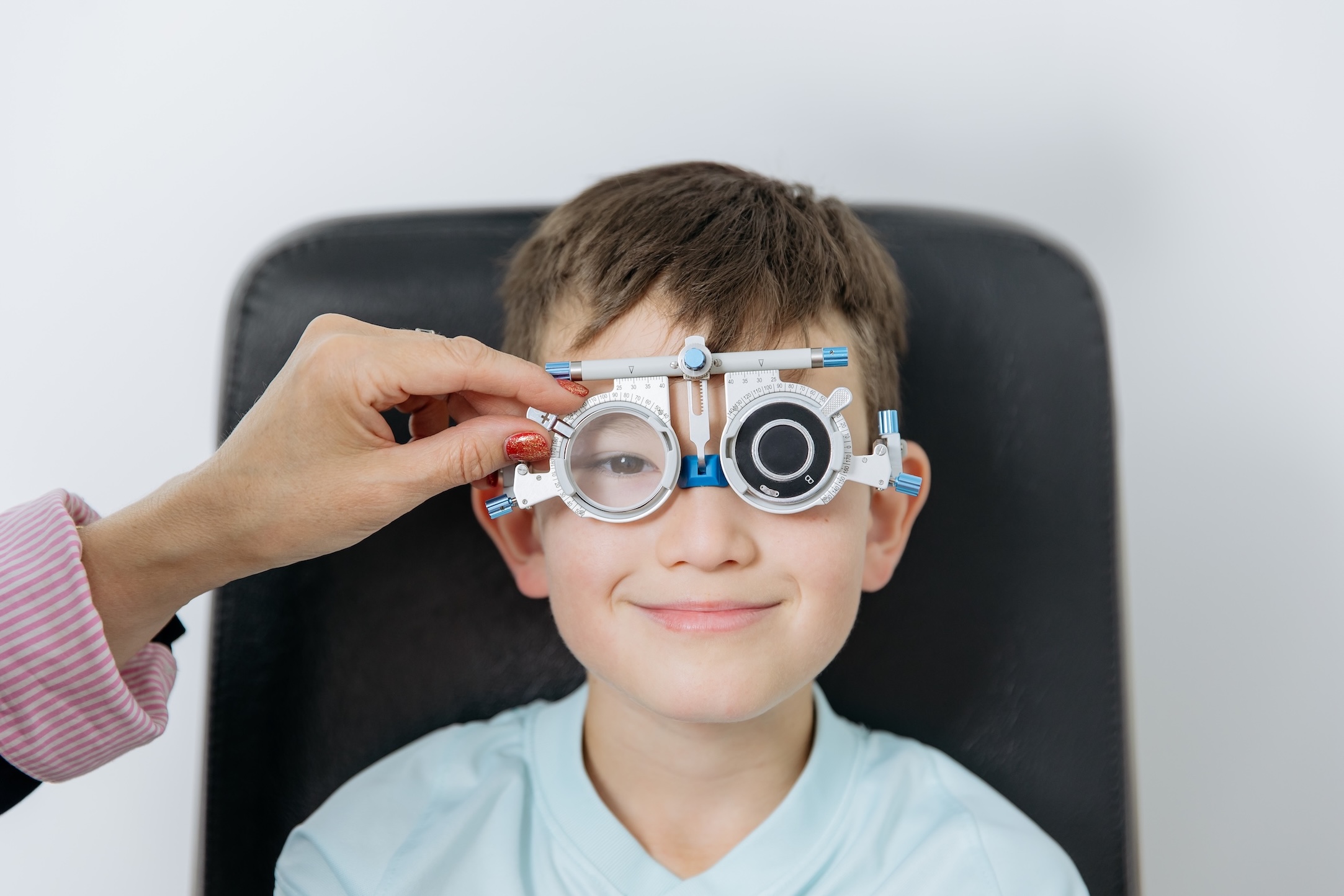
Repeated low-level red-light (RLRL) therapy is one of the newest tools in childhood myopia management: brief, comfortable sessions with a small light-emitting device, used at home under our supervision. Rose Optometry has treated more red-light therapy patients than any practice we are aware of outside China, and our affiliated New Zealand Eye Research Centre is actively researching red-light therapy alongside our other myopia treatments.
What the evidence actually shows
The key randomised controlled trial (Jiang et al., Ophthalmology, 2022) followed 264 Chinese children for 12 months. Read carefully, the results are genuinely encouraging but more nuanced than a single headline number suggests. Among children who used the device at least 75% of the time as directed, refraction progression was slowed by 87.7% and axial elongation by 76.8%, relative to controls, at that same compliance level. Looking at every child enrolled regardless of how consistently they used it — the more clinically honest “intention-to-treat” result — the effect was closer to 75% for refraction and 68% for axial length. In short: red-light therapy works best, and the well-known “87%” figure applies, only with consistent use — which is exactly why we build real compliance support into every red-light plan rather than simply handing over a device.
We think it is worth disclosing openly that this trial's senior author holds a financial interest (director/shareholder) in Eyerising, the company that manufactures the most widely studied device — a conflict worth knowing about when weighing any single body of evidence, however well the trial itself was conducted.
What we monitor that goes beyond the published safety guidance
Because red-light therapy is newer than spectacle or contact lens options, every red-light patient at Rose is monitored more closely than the published safety literature calls for: choroidal thickness measurement, angiography scans and choroidal vascularity index (CVI) tracking, on top of routine OCT and fundus photography. This has never turned up a safety concern in any of our patients to date, and it earns its place clinically, not just as a precaution — research (Xiong et al., Ophthalmology, 2023) has found that how much the choroid thickens in the first three months of treatment predicts how well a child's myopia will be controlled over the following year. That means we can often tell you, months earlier than a “wait and see” approach would, whether red-light therapy is working for your child.
The rebound effect: what happens if treatment stops
Red-light therapy's benefit is not banked permanently. If treatment stops, eye growth can speed back up — and the children who responded most strongly can also show the most rebound afterwards (Xiong et al., Clinical & Experimental Ophthalmology, 2022; Xie et al., 2026). This is not a reason to avoid red-light therapy; it is a reason to plan for the full course of treatment with us rather than starting and stopping on your own.
Combining treatments
Red-light therapy can be combined with spectacle lenses, soft contact lenses or ortho-K for an additional effect, but we do not combine it with atropine drops.
Book a new patient examination to talk through whether red-light therapy is right for your child, or start with a free Myopia Chat.
References & key studies
Jiang Y, Zhu Z, Tan X, et al. Effect of Repeated Low-Level Red-Light Therapy for Myopia Control in Children: A Multicenter Randomized Controlled Trial. Ophthalmology. 2022;129(5):509-519. PMID: 34863776.
Xiong R, Zhu Z, Jiang Y, et al. Longitudinal Changes and Predictive Value of Choroidal Thickness for Myopia Control after Repeated Low-Level Red-Light Therapy. Ophthalmology. 2023;130(3):286-296. PMID: 36240954.
Xiong R, Zhu Z, Jiang Y, et al. Sustained and Rebound Effect of Repeated Low-Level Red-Light Therapy on Myopia Control: A 2-Year Post-Trial Follow-Up Study. Clinical & Experimental Ophthalmology. 2022;50(9):1013-1024. PMID: 36054314.
Xie J, Zhang Z, Zhang T, et al. Efficacy and Rebound Effects of Repeated Low-Level Red Light versus High-Concentration Atropine for Myopia Control in Children: A Randomized Controlled Trial. Clinical & Experimental Ophthalmology. 2026;54(5):605-616. PMID: 41796439.
This article is general information, not a substitute for a personalised assessment. Whether red-light therapy is suitable for your child depends on their individual eyes and history — we discuss the evidence, including its limits, before recommending it.


See things the Rose way
Make an appointment at Hamilton’s leading eye care specialists.

