Scleral Lenses: Who They Help, the Downsides and How Long They Last
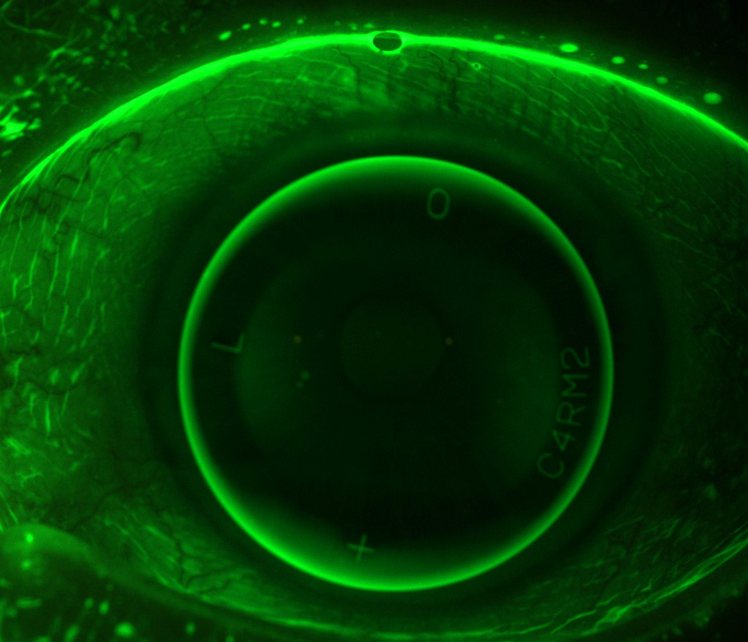
Scleral lenses are large rigid gas-permeable contact lenses that vault over the cornea on a layer of fluid and rest on the white of the eye. They are mainly fitted for irregular corneas, such as keratoconus, and some ocular surface disease. They can sharpen vision considerably, but fogging and handling are common challenges.
If glasses or soft lenses no longer give you clear vision, this guide from the optometrist team at Rose Optometry in Hamilton explains who scleral lenses may help, what the research shows, and what to expect.
What is a scleral lens used for?
A scleral lens does not touch the cornea. It sits over a reservoir of fluid, so the lens's smooth front surface does the focusing rather than the irregular cornea underneath. In a survey of 777 practitioners, a median of 84% of scleral lenses were fitted for corneal irregularity and 10% for ocular surface disease (Nau 2022). Common reasons include:
- Keratoconus and other corneal thinning conditions
- Irregular corneas after a corneal graft or other surgery
- Severe ocular surface disease, where the fluid reservoir bathes the cornea
Scleral lenses are rarely needed for an ordinary glasses prescription.
How much can scleral lenses improve vision?
For people with irregular corneas, the change can be substantial. In a study of 157 eyes of established keratoconus wearers, average vision improved from logMAR 0.50 in glasses to 0.08 in lenses, roughly 6/19 to about 6/7.5 on a vision chart (Fuller 2020). That study left out people who stopped in their first year, so it describes those who carried on rather than everyone who tries them. Your own result depends on your eyes.
Can scleral lenses help you avoid a corneal transplant?
They may reduce the need for one in some people, but this has not been tested in a randomised trial. In one series of 75 eyes with severe keratoconus, scleral lenses were prescribed for 51. At last follow-up, an average of about two and a half years later, 40 of those eyes were still wearing them. There was no comparison group (Koppen 2018). A large US records study found lower transplant rates in scleral lens wearers than in people wearing no lens (hazard ratio 0.19, 95% CI 0.09 to 0.39), and corneal RGP lenses showed a similar pattern (Ling 2021). These are associations and do not prove the lens was the reason.
Scleral lenses improve vision but are not a treatment that stops keratoconus changing. Your optometrist will still monitor your corneas and can refer you for corneal cross-linking or a surgical opinion when that is appropriate.
What are the downsides of scleral lenses?
- Midday fogging: reported in 7% of eyes in one series, and 26% to 46% of wearers in a review (Fuller 2020; Rodriguez-Garcia 2025). You may need to take the lens out, refill it and put it back.
- Handling: handling problems were the most common difficulty among people who stopped in one series; 34.2% of 120 US veterans stopped overall (Kanakamedala 2020). It takes practice, and tools can help.
- Lost or damaged lenses: 26.1% of 157 eyes in one series (Fuller 2020). This is worth planning for.
- Corneal swelling: practitioners' one-year estimate of wearers who stopped because of it was 1.2%, in a survey covering 72,605 wearers (Schornack 2023). This is why check-ups matter.
- Infection: practitioners' one-year estimate of wearers who stopped because of microbial keratitis was 0.45% in the same survey (Schornack 2023). Uncommon but serious. Rough estimates exceed other lens types, partly from existing eye disease. Do not sleep in them unless prescribed.
EyeSpace Scleral lenses, which we fit at Rose, are designed to help reduce midday fogging, using a smaller diameter, fenestrations in the landing zone and optimised parameters including lens thickness. We have not found published trials of this design, and results vary between patients. Jagrut Lallu is a director and shareholder of the company behind EyeSpace.
How long do scleral lenses last?
There is no agreed replacement time that we could find in the research. At one US hospital, patients who reordered did so after an average of 23.9 months, with a very wide range (Pritikin 2023). That tells us how often people reordered, not how long a lens is safe to use. Your optometrist will advise on replacement based on the lens surface, its fit and your eye health.
How much does a scleral lens cost?
Scleral lenses are custom-fitted, so your cost depends on your eyes and the design you need. We will explain fees before you start. If you have keratoconus, a Health NZ contact lens subsidy may apply. There are optometrist fees on top of that subsidy for fitting, refitting, new lenses and replacement lenses.
How do you look after scleral lenses?
A review of scleral lens practice describes preservative-free saline or preservative-free artificial tears as the commonly agreed options for filling the lens (Rodriguez-Garcia 2025). Your optometrist will show you how to insert, remove and clean your lenses, and which products suit them. Lens cases, tools and care products are in our store's scleral and specialty lens care range. For more on living with these lenses, see scleral lenses for keratoconus on KCNZ.
How are scleral lenses fitted at Rose Optometry?
- A full examination and corneal imaging, to find out what is causing your vision problem and whether a scleral lens is the right option.
- Trial or custom lens fitting. Expect more than one visit.
- Training in handling and care.
- Regular follow-up to check your cornea, your vision and how the lens is sitting.
Scleral lenses are one option among several. Corneal RGP, hybrid or other specialty lenses may suit you better, and keratoconus care at Rose Optometry covers the alternatives. The optometrist team, including Jagrut Lallu, Jacqueline Rowe, Emilie Lawson, Jason Shen and Stella Wong, sees patients at 38 Lake Road, Frankton, Hamilton.
- New to Rose with keratoconus: book a keratoconus appointment
- Already a Rose keratoconus patient: book your review
If you wear scleral lenses and get a painful or red eye, or strong light sensitivity, take the lenses out and phone us the same day on 07 847 3195. For sudden loss of vision, go to the hospital emergency department.
Last reviewed 3 November 2026 by the Rose Optometry optometrist team.
References
- Nau CB, et al. Eye Contact Lens. 2022. PMID 36440667. DOI
- Fuller DG, Wang Y. Optom Vis Sci. 2020. PMID 32932400. DOI
- Koppen C, et al. Am J Ophthalmol. 2018;185:43-47. PMID 29103959. DOI
- Ling JJ, et al. Cornea. 2021. PMID 32452985. DOI
- Rodriguez-Garcia A, et al. Med Hypothesis Discov Innov Ophthalmol. 2025. PMID 41111638. DOI
- Kanakamedala A, et al. Eye Contact Lens. 2020. PMID 31794543. DOI
- Schornack MM, et al. Eye Contact Lens. 2023. PMID 36602410. DOI
- Pritikin E, et al. Eye Contact Lens. 2023. PMID 37498983. DOI


See things the Rose way
Make an appointment at Hamilton’s leading eye care specialists.

