Presbyopia eye drops: are VIZZ, Qlosi and Yuvezzi available in New Zealand?
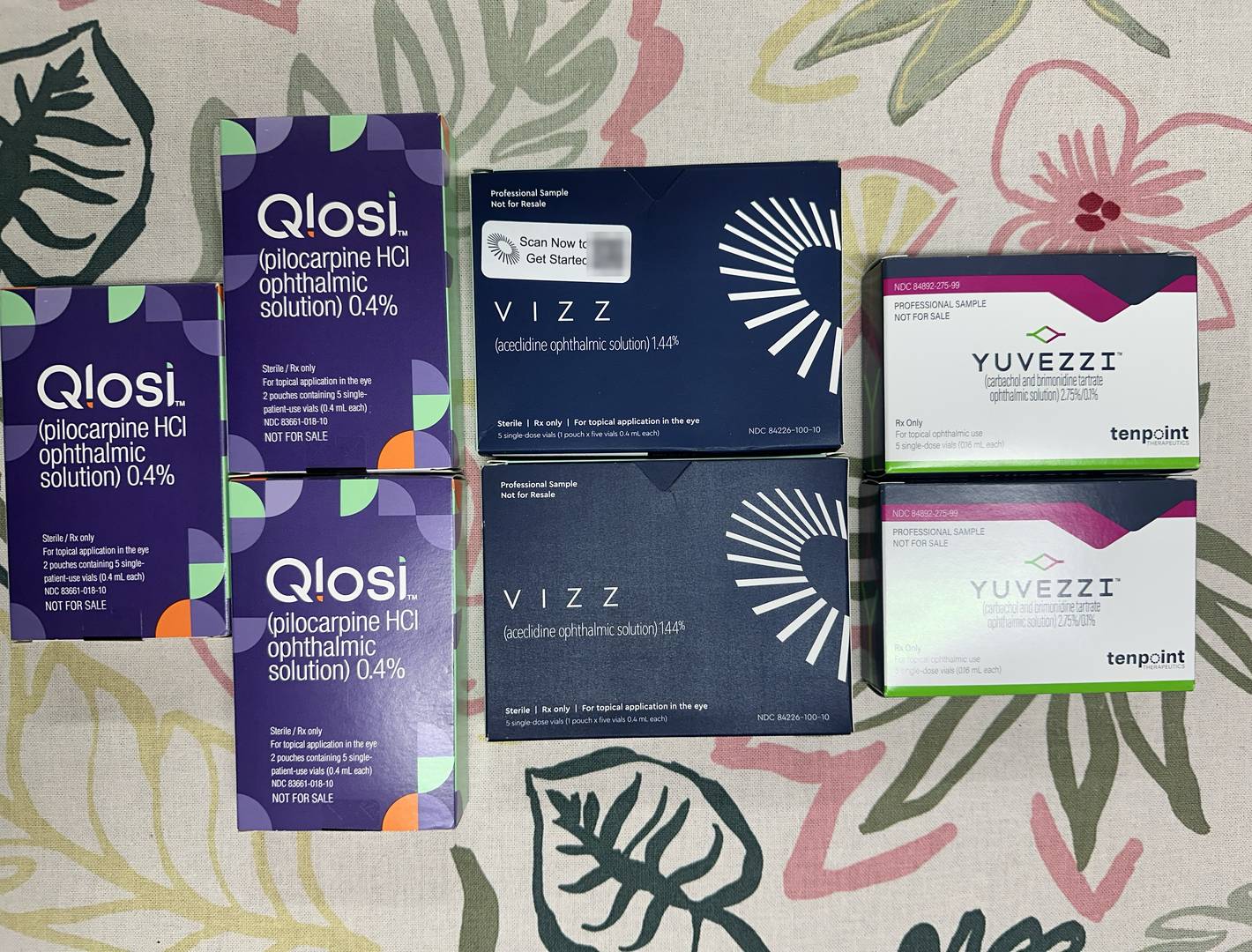
Short answer: no. As at 6 November 2026, Qlosi, VIZZ and Yuvezzi, three prescription eye drops for presbyopia now sold in the United States, have not been approved by Medsafe, and Medsafe's public database shows no application lodged for any of them. VIZZ and Yuvezzi each have a named commercial partner for Australia and New Zealand, and Qlosi is under evaluation in Australia. Our read is that none of them will be an approved medicine in New Zealand before 2027, and it could be later or not at all.
Rose Optometry partner Jagrut Lallu was given professional samples of all three drops (pictured) on a recent trip to the United States. The drops are not approved medicines in New Zealand. We do not sell or supply them, and this article is not an offer to do so. It sets out what the drops are, what the trial evidence shows, where they stand with regulators, how they could be prescribed, and how to hear from us if their status changes.
What presbyopia is, and how the drops work
Presbyopia is the gradual loss of near focus that comes with age. The first symptoms typically appear at around 40. It is managed with reading glasses, progressive or occupational lenses, multifocal or monovision contact lenses, orthokeratology (lenses worn overnight that reshape the front of the eye) and, for some people, lens surgery such as refractive lens exchange.
All three drops are miotics: they make the pupil smaller. A smaller pupil works like a pinhole and increases the eye's depth of focus, so near print looks sharper. The effect wears off within hours, so a drop treats the day it is used. It does not reverse presbyopia.
In the trials below, a “response” meant reading at least three more lines on a near-vision chart without losing a line of distance vision.
The three drops
Qlosi (pilocarpine hydrochloride 0.4%), Orasis Pharmaceuticals. Approved by the US Food and Drug Administration (FDA) in October 2023. It is preservative-free and comes in single-use vials: one drop in each eye, which can be repeated after two to three hours, up to twice a day, for an effect of up to eight hours. In its two trials (NEAR-1 and NEAR-2; 613 adults aged 45 to 64, 309 of whom received Qlosi), 39% and 42% of people using Qlosi responded one hour after the first dose on day 8, compared with 17% and 21% of people using the same drop without the active ingredient. The most common side effects were pain on instillation and headache (each in 5 to 8% of people), and blurred vision (2 to 5%).
VIZZ (aceclidine 1.44%), LENZ Therapeutics. Approved by the FDA on 31 July 2025 and sold in the US since October 2025. It is also preservative-free in single-dose vials: one drop in each eye, a second drop two minutes later, once a day. The label describes an effect from 30 minutes that lasts 10 hours. In the two trials behind the approval (CLARITY-1 and CLARITY-2; 466 adults aged 45 to 75 across the VIZZ and comparison groups, 234 of whom received VIZZ), 65% and 71% responded three hours after the first dose, compared with 12% on a comparison drop (brimonidine) and 8% on the drop without the active ingredient. The FDA's own review shows the effect fading through the day: at 10 hours on day 1, 27% and 40% were still responding. The most common side effects were irritation on instillation (20%), dim vision (16%) and headache (13%), with eye redness recorded under two headings at 8% and 7%. The FDA's pooled safety review of the three CLARITY trials also recorded floaters in 5.0% of people using VIZZ, against 0.7% of those using the drop without the active ingredient.
Yuvezzi (carbachol 2.75% and brimonidine tartrate 0.1%), Tenpoint Therapeutics. Approved by the FDA on 28 January 2026, and the only one of the three that combines two active ingredients. It is preservative-free in single-dose vials: one drop in each eye, once a day. In its larger trial (BRIO II; 436 adults, half of whom received Yuvezzi), 38% responded one hour after the dose, compared with 4% on the drop without the active ingredients. By eight hours it was 10% against 3%. In the other trial (BRIO I), the combination did better at one hour (49%) than carbachol alone (35%) or brimonidine alone (23%). Both trials enrolled adults aged 45 to 80. The side effects reported were eye irritation on instillation and headache (each in more than 10% and up to 16% of people), and eye pain on instillation and visual impairment (each in more than 5% and up to 7%). Because it contains brimonidine, the label also advises caution for people with depression, Raynaud's phenomenon, low blood pressure on standing and some other circulation problems.
These percentages cannot be compared between the drops. No trial has tested one against another, and each programme measured success differently: on different days, at different times after the dose, with one eye or both, and with or without distance glasses. Even among people using a drop with no active ingredient, the response ranged from 4% in one trial to 21% in another, which shows how much the measuring method drives the numbers.
A fourth drop, Ryzumvi (phentolamine 0.75%, Viatris), had presbyopia added to its US approval in October 2026. It belongs to a different class of medicine, is used once a day at night, and is not covered here. It has no Medsafe approval either.
The risks worth knowing about
All three US labels carry the same class warnings, and they shape how these drops would be used:
- Dim or dark vision. A small pupil lets in less light. The labels advise caution with night driving and other hazardous activities in poor light, and not driving or using machinery if vision is blurred.
- Retinal tears and detachment. The labels note rare cases of retinal tear or detachment with miotic drops, advise an examination of the retina in every patient before starting, and tell patients to seek immediate care for a sudden onset of flashing lights, floaters or loss of vision. A systematic review of reports up to April 2023 counted retinal detachment in five eyes of four people who had used an earlier presbyopia drop, pilocarpine 1.25%. Three of those eyes were short-sighted and three had a lens implant.
- Inflammation inside the eye. The Qlosi and Yuvezzi labels say the drops are not recommended when iritis is present, and the VIZZ label advises caution in anyone with a history of iritis.
- Contact lenses. Lenses come out before the drop goes in and stay out for 10 minutes.
Who was, and was not, studied
The trials left out many of the people we see every day. The Qlosi and VIZZ trials excluded people with more than about 4 to 4.5 dioptres of short-sightedness, glaucoma or raised eye pressure, diabetes, significant cataract, significant retinal disease, any history of iritis or uveitis, and pregnancy. The Qlosi label adds that safety and effectiveness have not been established in people over 65. The entry criteria for the Yuvezzi trials have not been published in the same detail. None of this means the drops are unsafe for those groups. It means it has not been measured.
It also helps to keep expectations realistic. In each trial, even at the best time point reported, between roughly three and six in ten people did not reach the response threshold, and the effect faded as the day went on. These drops are not a replacement for glasses for everyone, and the trials did not measure how often people could go without reading glasses.
Are they available in New Zealand?
No. On 6 November 2026 we searched Medsafe's product and application database for each brand name (Qlosi, its Australian name Beska, VIZZ and Yuvezzi) and for the ingredient aceclidine. There is no approved product and no application on record for any of them.
New Zealand does have approved pilocarpine eye drops, but only at 1%, 2% and 4%, which is 2.5 to 10 times the strength of the 0.4% in Qlosi. They are different products and are not a substitute.
It is also worth knowing that the first eye drop approved for presbyopia in the US, Vuity (pilocarpine 1.25%), was approved in October 2021 and never came here. Medsafe has no record of an application for it, and the FDA now lists it as discontinued.
When might they arrive?
Nobody has announced a New Zealand date. This is what is on the public record:
- VIZZ. In June 2026 LENZ Therapeutics licensed VIZZ to Arrotex Pharmaceuticals, an Australian company, to register and sell it in Australia and New Zealand. No filing or launch date has been given. LENZ has reported applications lodged in Europe, the United Kingdom, Canada and several other countries, and its October 2026 update did not report an approval outside the US.
- Qlosi. Australia's regulator, the Therapeutic Goods Administration (TGA), accepted an application for evaluation in June 2026. Aspen Pharmacare Australia, which lodged it, says it is preparing for approval and launch in Australia in 2027 under the name Beska. The announcement covers Australia only.
- Yuvezzi. In January 2025 Zhaoke Ophthalmology, a partner of Tenpoint, announced that AFT Pharmaceuticals, a New Zealand company, would register and distribute the drop (then called Brimochol PF) in Australia and New Zealand. No filing or launch date has been given. Tenpoint has applied to the UK regulator, and in August 2026 it announced a licence for Europe and the UK with a subsidiary of Lupin.
A change in New Zealand law could shorten the wait. Since July 2026 Medsafe has had a “verification pathway”. A medicine that already holds full approval from two recognised overseas regulators (those of Australia, the United States, Canada, the United Kingdom, the European Union, Singapore and Switzerland) can be approved here on the strength of that work, with a decision due within 30 working days of a validated application, not counting time spent waiting for further information. Each of these drops has one such approval so far, from the FDA. A second approval could make a drop eligible, but only if it comes from a full evaluation. Approvals granted by relying on another regulator's decision do not count, and that includes the UK route Tenpoint is using for Yuvezzi. The approvals relied on must also be no more than four years old, which for Qlosi (approved by the FDA in October 2023) means an application by October 2027. And a company still has to choose to apply.
Our read: none of these drops will be an approved medicine in New Zealand before 2027, it could easily be later, and some may never come. We will update this article as the facts change.
How could they be prescribed here?
Today. Not through a pharmacy in the ordinary way, because a medicine needs consent under the Medicines Act before it can be sold, supplied or advertised in New Zealand. The Act has two exemptions for individual patients:
- Section 29 lets a licensed wholesaler or a pharmacy import an unapproved medicine and supply it on prescription for a particular patient. Those prescriptions can only be written by a medical practitioner, nurse practitioner or pharmacist prescriber. Optometrists are not on that list.
- Section 25 lets any authorised prescriber, which includes an optometrist working within their scope of practice, obtain an unapproved medicine for a particular patient under their care, for example by importing it directly. Medsafe describes direct importation as complex, and it can only be done for a patient who is known and identified at the time.
Either way, the patient has to give informed consent to using a medicine that Medsafe has not assessed. These are individual clinical decisions made in a consultation. Nothing in this article is an offer to supply these drops.
Medsafe's rules also allow an individual to import a prescription medicine for personal use under strict conditions, including a letter or prescription from a New Zealand prescriber and a limit of three months' supply. Medsafe discourages importing medicines it has not reviewed, and we do not recommend it for these drops. A buyer could not be sure that a pack shipped internationally had stayed within its labelled storage limits, and the retinal examination the labels advise still has to come first.
If approved. If Medsafe approves any of these drops as a prescription medicine, as they are in the US, any of our optometrists could prescribe it. All are therapeutically qualified, which means they can prescribe eye medicines within their scope of practice. We would expect it to work like this:
- A comprehensive eye examination, including an examination of the retina, which the US labels advise for every patient before starting.
- A conversation about whether you are like the people the trials studied, how much you drive at night, your work and hobbies, and what result you can realistically expect.
- A prescription to fill at a pharmacy, and a follow-up visit to check your vision and comfort on the drop.
No New Zealand price has been announced for any of them.
What you can do now
You do not need to wait for a drop to see comfortably up close. Our presbyopia page explains the options available today, from reading and progressive lenses to multifocal contact lenses. If your near vision has changed, a full eye examination is the place to start. Two other options are worth knowing about, and the first is one we offer now.
Orthokeratology (Ortho-K) for presbyopia. Ortho-K for presbyopia is what sets Rose Optometry apart: we have been fitting it since 2009, and it is a non-surgical option our optometrist team offers now. Rigid lenses worn overnight gently reshape the front surface of the cornea, so you can see during the day without glasses or daytime contact lenses, and the effect is reversible if you stop. For presbyopia we use hyperopic Ortho-K, which steepens the centre of the cornea to bring near vision into focus, usually in one eye (monovision) or with a customised design. Partner optometrist Jagrut Lallu holds a master's degree in specialty lenses, with research on hyperopic orthokeratology, and is a Fellow of the International Academy of Orthokeratology and Myopia Control. The published research in presbyopia is still small. A 2024 international review found one published study: 13 people with presbyopia and no distance prescription wore a lens overnight in one eye for a week. Near vision in that eye improved from Jaeger 10.8 to between Jaeger 3.2 and 3.9 (smaller numbers mean smaller print), with no change in distance vision with both eyes open. The review notes that the result can fall short of the near correction aimed for, and that haloes and glare in low light can affect the quality of vision, so the fit is tailored and reviewed. The most serious risk of any overnight lens is a corneal infection: a systematic review estimates 7.7 cases of microbial keratitis per 10,000 patient-years with overnight Ortho-K, similar to other overnight lens wear, which is why careful lens hygiene matters. Read more on our orthokeratology page, or book a free 15-minute Ortho-K chat with one of our optometrists.
Refractive lens exchange (lens replacement). This is surgery, performed by an ophthalmologist. The eye's clear natural lens is removed and replaced with an artificial lens, using the technique of cataract surgery. The eye's own remaining focusing ability goes with the natural lens, and a cataract cannot develop later. Reviews describe the typical candidate as someone over 50 who is long-sighted and already needs reading glasses. In one refractive surgery provider's records of 1,280 patients aged 45 to 65 who had a multifocal lens implanted, 78% to 85% could read 20/30 print or better without glasses, using both eyes, three months after surgery. Up to about 10% reported significant haloes or glare, and 7% to 11% reported significant difficulty driving at night. Retinal detachment is the most sight-threatening risk. A 2025 meta-analysis found it was about twice as common after lens replacement as after cataract surgery, and the risk is higher in short-sighted eyes. Our optometrists do not perform this surgery. We can take the pre-operative measurements, talk through whether a referral makes sense for you, and see you for the checks afterwards. Our article on lens replacement and implantable lenses has the detail.
Keep in touch
If you would like to hear from us when the regulatory status of any of these drops changes in New Zealand, let us know. Send a message through our contact page, email info@roseoptom.co.nz with “presbyopia drops” in the subject line, phone 07 847 3195, or mention it at your next visit. You can also follow us on Facebook and Instagram, and we will update this article as things change.
Common questions
Can I buy VIZZ, Qlosi or Yuvezzi in New Zealand?
No. None of them has been approved by Medsafe, and as at 6 November 2026 no application for any of them appears in Medsafe's database.
Can a New Zealand optometrist prescribe presbyopia eye drops?
Not through a pharmacy in the usual way, because none is approved here. Prescriptions under section 29 of the Medicines Act are limited to doctors, nurse practitioners and pharmacist prescribers. Section 25 lets any authorised prescriber, including an optometrist, obtain an unapproved medicine for a particular patient under their care, which is an individual clinical decision. If a drop is approved as a prescription medicine, therapeutically qualified optometrists will be able to prescribe it within their scope of practice.
Are the pilocarpine eye drops already approved in New Zealand the same thing?
No. The pilocarpine drops approved in New Zealand are 1%, 2% and 4%. Qlosi is 0.4%, and the others use different active ingredients.
What are the alternatives to presbyopia eye drops in New Zealand?
Reading glasses, progressive or occupational lenses, multifocal or monovision contact lenses, orthokeratology and, for suitable people, refractive lens exchange surgery. All are available in New Zealand now.
Can orthokeratology correct presbyopia?
It can for some people. Hyperopic Ortho-K lenses worn overnight reshape the cornea to give near focus, usually in one eye, and the effect wears off if you stop. It is fitted after an eye examination and corneal mapping, and our optometrists will tell you whether your eyes suit it. You can start with a free 15-minute Ortho-K chat.
Will the drops replace reading glasses?
The trials did not measure that. They measured lines read on a near-vision chart in the hours after a drop. Many people did not reach the three-line threshold, and the effect lasted hours, not all day and night.
Our optometrists
Presbyopia care is part of the clinical practice of all of our therapeutically qualified optometrists: partners Jagrut Lallu and Jacqueline Rowe, and optometrists Emilie Lawson (Accredited Glaucoma Prescriber), Jason Shen, Stella Wong and Anjali Hira.
Book a comprehensive eye examination with our team: new patients book here or existing patients book here.
This article is general information, not individual advice and not an advertisement for any medicine. None of the products named is approved in New Zealand, and Rose Optometry does not supply them. The samples pictured were given to Jagrut Lallu in the United States as an eye-care professional. Regulatory status was checked on 6 November 2026. Trial figures are taken from the US prescribing information and FDA review documents. We could not find a peer-reviewed publication of the phase 3 trials of VIZZ or Yuvezzi on PubMed when we checked.
References
- Qlosi (pilocarpine hydrochloride ophthalmic solution) 0.4%, US prescribing information. DailyMed. FDA approval letter, NDA 217836, 17 October 2023, and FDA Clinical Review, NDA 217836.
- VIZZ (aceclidine ophthalmic solution) 1.44%, US prescribing information. DailyMed. FDA Integrated Review, NDA 218585.
- Yuvezzi (carbachol and brimonidine tartrate ophthalmic solution) 2.75%/0.1%, US prescribing information. DailyMed. FDA approval letter, NDA 220142, 28 January 2026.
- Ryzumvi (phentolamine ophthalmic solution) 0.75%, US prescribing information, revised October 2026. Drugs@FDA, NDA 217064.
- Singh M, et al. J Curr Ophthalmol. 2024;36(2):111-121. PMID 40012805. DOI
- Katz JA, et al. Clin Ophthalmol. 2021;15:2167-2178. PMID 34079215. DOI
- Craig JP, et al. BCLA CLEAR Presbyopia: management with corneal techniques. Cont Lens Anterior Eye. 2024;47(4):102190. PMID 38851946. DOI
- Liu YM, Xie P. Eye Contact Lens. 2016;42(1):35-42. PMID 26704136. DOI
- Alió JL, et al. Eye Vis (Lond). 2014;1:10. PMID 26605356. DOI. Trojacka E, et al. J Clin Med. 2025;15(1):215. PMID 41517464. DOI
- Schallhorn SC, et al. Clin Ophthalmol. 2017;11:1569-1581. PMID 28894356. DOI
- Passaro ML, et al. Br J Ophthalmol. 2025;109(7):756-764. PMID 40015940. DOI
- Medsafe. Product/Application Search, searched 6 November 2026.
- Medsafe. Use of unapproved medicines and use of approved medicines for an unapproved purpose, revised 12 December 2025. Medicines Act 1981, sections 20, 25 and 29.
- Medsafe. Importing medicines for personal use.
- Ministry of Health. Medicines Amendment Act: verification pathway. Medsafe. Verification pathway for new medicine applications, July 2026.
- Therapeutic Goods Administration. Prescription medicines under evaluation: Qlosi, Aspen Pharmacare Australia, accepted June 2026.
- LENZ Therapeutics. Licence agreement with Arrotex Pharmaceuticals for VIZZ in Australia and New Zealand, 24 June 2026; second-quarter 2026 results; third-quarter 2026 results, 28 October 2026.
- Orasis Pharmaceuticals. Australian submission for Beska, 15 July 2026.
- Zhaoke Ophthalmology. Agreement with AFT Pharmaceuticals for Brimochol PF in Australia and New Zealand, 13 January 2025. Eyewire. Lupin and Tenpoint Therapeutics partnership to commercialise Yuvezzi, 20 August 2026.
- US Food and Drug Administration. Drugs@FDA: Vuity, NDA 214028. AbbVie. FDA approval of Vuity, 29 October 2021.
Recent articles


See things the Rose way
Make an appointment at Hamilton’s leading eye care specialists.

