Getting an eye test in Hamilton: what actually happens, and how to choose
Most people book an eye test because something has changed: words on the phone are harder to read, night driving feels glarier, or the headaches have crept in. What they rarely know is what a thorough examination actually involves, or why one practice charges $60 and another $180. This is a plain description of what happens at a proper eye examination in Hamilton, written so you can judge any practice you visit — ours included.
What a thorough eye examination includes
An eye test is two things at once: a measurement of how well you see, and a health check of the eye itself. The second half is the part that matters most and the part most easily skipped.
- History and symptoms. What you have noticed, your general health, medications, family history of glaucoma, macular degeneration or keratoconus, and what you actually need your eyes to do — milking at 5am, screens all day, night driving on the Waikato Expressway.
- Vision and refraction. Measuring your prescription for distance and near, including astigmatism, and checking how the two eyes work together.
- Eye pressure and optic nerve. Screening for glaucoma, which usually causes no symptoms until sight is already lost.
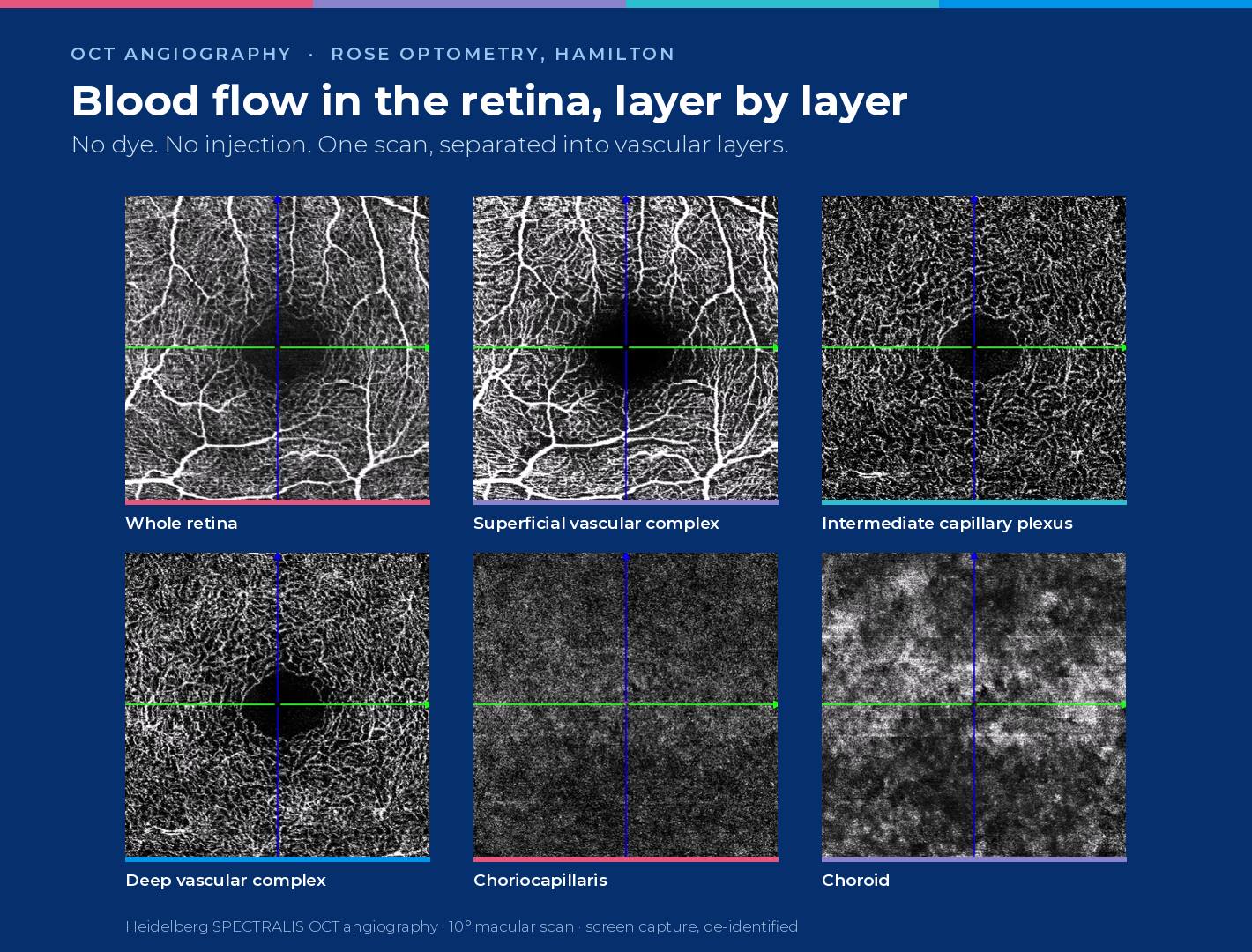
- Retinal examination and imaging. A look at the back of the eye, ideally with a photograph or scan kept on file, so this year can be compared with next year. Comparison over time is how early change is caught.
- Front of the eye and tear film. The cornea, lids and tears — where dry eye, blepharitis and early keratoconus show up.
- An explanation you can act on. What was found, what it means, what to do, and what to watch for.
A comprehensive examination usually takes 30 to 45 minutes. If you are in and out in ten, you have had a sight test, not an eye examination.
How often should you have your eyes examined?
As a general guide, adults every two years, and annually if you are over 65, have diabetes, have a family history of glaucoma or macular degeneration, wear contact lenses, or have been told to come back sooner. Children should be checked before starting school and then every one to two years — sooner if they sit close to the screen, lose their place when reading, get headaches, or a teacher raises it. Children rarely complain about blurry vision, because they assume everyone sees the way they do.
Costs and what is subsidised in New Zealand
Adult eye examinations in New Zealand are generally paid privately and are not funded by Te Whatu Ora. Prices vary with what is included — retinal imaging, visual field testing and extra time all cost money to provide, which is most of the difference between a cheap and an expensive test. Ask what is included before you book.
Two things worth knowing: children and young people may be eligible for subsidised vision services in some circumstances, and if you hold a Community Services Card there are funding options for children's glasses. Some eye conditions found at an examination are referred into the public hospital system and treated there. If cost is a barrier, say so — practices can usually work something out, and an untreated eye problem is far more expensive than an examination.
When it is urgent, not routine
Book the same day, or go to hospital, if you have sudden loss of vision, a curtain or shadow across your vision, a sudden shower of new floaters or flashing lights, a red painful eye with light sensitivity, or double vision that has come on suddenly. These are not “wait and see” symptoms. In Hamilton you can call us on 07 847 3195 for an urgent appointment during opening hours.
How to choose an optometrist in Hamilton
There are good practices across the city, and the right one depends on what you need. Some questions that separate them:
- What is included in the examination, and how long is it? Time is the honest proxy for thoroughness.
- Do you keep retinal images year to year? Comparison is where early disease is found.
- Who owns the practice, and does the same optometrist see me each time? Continuity matters for anything chronic.
- What happens if something is found? A practice that refers promptly and follows up afterwards is worth more than one that simply sells you glasses.
- Am I free to take my prescription elsewhere? The answer should be an unhesitating yes. Your prescription is yours.
- Do they have the equipment for what I actually have? Corneal mapping for keratoconus, meibography for dry eye, axial length for a child's myopia. If the practice cannot measure it, they cannot manage it well.
What we do at Rose Optometry, and where we would send you elsewhere
Rose Optometry has been in Frankton since 1969 and is optometrist-owned. Our examinations run 30 to 45 minutes and include retinal imaging kept on file. We have particular depth in areas that need equipment and repetition: keratoconus (the Rose K lens was designed here in the Waikato), dry eye, myopia control in children and ortho-k.
We are not the right practice for everything. Eye surgery, injections and acute hospital care belong with ophthalmologists, and we refer directly when that is what you need. If another practice is better placed for something specific, we will tell you, because sending you to the right place is the job.
Booking
Rose Optometry, 38 Lake Road, Frankton, Hamilton 3204. Phone 07 847 3195, email info@roseoptom.co.nz, or book online. Open Monday, Tuesday and Friday 8am–5pm, Wednesday 8am–6pm, Thursday 8am–7pm, and Saturday 9am–1pm. We see patients from across Hamilton, Cambridge, Te Awamutu, Morrinsville, Huntly and Raglan.
Written by Jagrut Lallu — BOptom (Hons), MSc Specialty Lenses (Hons), FIAOMC. Therapeutic Optometrist & Contact Lens Specialist; Partner, Rose Optometry. Last reviewed 16 August 2026. General information only, not a substitute for an examination.
Recent articles
See things the Rose way
Make an appointment at Hamilton’s leading eye care specialists.

