MiyoSmart & Stellest Lenses: Advanced Spectacle Options for Myopia
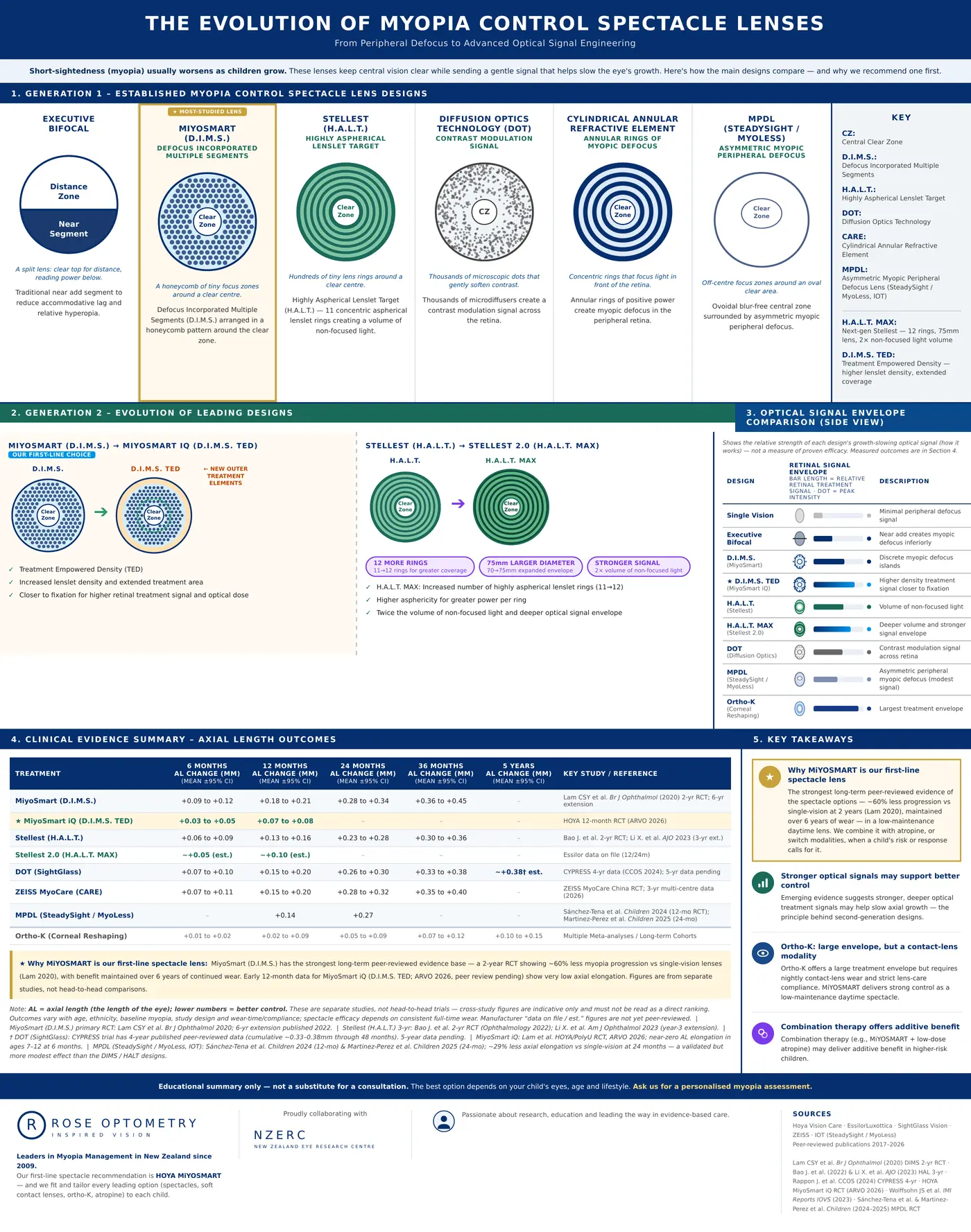
MiyoSmart and Stellest are advanced spectacle lens designs built specifically to manage childhood myopia — not just correct it. Unlike ordinary single-vision glasses, they use special optical zones woven into the lens to create a deliberate “defocus” signal that slows the eye's growth, while keeping central vision sharp for everyday use.
What the evidence shows
In the 2-year randomised clinical trial behind MiyoSmart's DIMS lens design (Lam et al., British Journal of Ophthalmology, 2020), children wearing it had 52% less change in prescription (refraction) and 62% less growth in the length of their eye (axial length) than children in ordinary single-vision lenses. Stellest, a different lenslet design evaluated in a separate 2-year trial (Bao et al., JAMA Ophthalmology, 2022), slowed prescription change by 55% and axial growth by 51% overall — rising to about 68% and 59% respectively for children who wore the lenses at least 12 hours a day. As with all myopia-control figures, refraction and axial length are two different measures of the same condition, and axial length is the one that carries the lifelong eye-health risk.
Why families choose a spectacle option
Both lenses look like ordinary glasses, require no lens-wearing routine, and suit almost any child — making them one of our most common first steps. They can be combined with low-dose atropine drops or red-light therapy for additional effect (though we do not combine atropine and red-light therapy with each other).
Book a new patient examination for your child to find out if MiyoSmart or Stellest suits them.
References & key studies
Lam CSY, Tang WC, Tse DY, et al. Defocus Incorporated Multiple Segments (DIMS) Spectacle Lenses Slow Myopia Progression: A 2-Year Randomised Clinical Trial. British Journal of Ophthalmology. 2020;104(3):363-368. PMID: 31142465.
Bao J, Huang Y, Li X, et al. Spectacle Lenses With Aspherical Lenslets for Myopia Control vs Single-Vision Spectacle Lenses: A Randomized Clinical Trial. JAMA Ophthalmology. 2022;140(5):472-478. PMID: 35357402.
This article is general information, not a substitute for a personalised assessment. Results vary from child to child.
Recent articles
See things the Rose way
Make an appointment at Hamilton’s leading eye care specialists.

