Myopia Control for Children in Hamilton: Every Evidence-Based Treatment, Under One Roof
If your child's glasses get stronger every year, that is not something you simply have to keep correcting with thicker lenses — it is something we can actively treat. Short-sightedness (myopia) is now recognised around the world as a condition of eye growth worth treating early, not just a vision problem to patch up. And the earlier we start, the more of your child's future eyesight we can protect.
Rose Optometry is home to New Zealand's first dedicated myopia control clinic. Our founder, optometrist Jagrut Lallu, opened it back in 2009 — when most Kiwi children were still simply handed a stronger prescription each year. Since then we have been quietly advocating for every practitioner in the country to adopt treatment as the first line of management. This is why we have banned the sale of single vision distance glasses for myopia. We have been refining children's myopia treatment for longer than anyone in the country, and today we offer the full range of evidence-based options to slow it down. This guide walks through each one, who it suits, and how we build a plan around your child.
Why we treat myopia, not just correct it
Myopia happens because the eyeball grows a little too long, so distance vision blurs. The stronger a child's short-sightedness becomes, the higher their lifetime risk of serious eye conditions as an adult — including retinal detachment, macular disease and glaucoma (conditions that can permanently affect sight). Research is clear that every step we prevent your child's prescription from climbing meaningfully lowers that lifetime risk. So our goal is not just clearer vision this year — it is a healthier, safer eye for life, measured objectively by tracking the actual length of your child's eye at every visit. Our approach is grounded in ongoing clinical research through our affiliated New Zealand Eye Research Centre.
Worried your child's eyesight is getting worse? Start with a free Myopia Chat with one of the experts — no cost, no obligation, just a conversation about your options. Book your free Myopia Chat →
The full range of myopia treatments we offer
There is no single "best" treatment for every child — the right choice depends on their age, prescription, lifestyle and how fast their myopia is progressing. Because we offer all of the options below, we can match the treatment to your child rather than squeezing your child into one option.
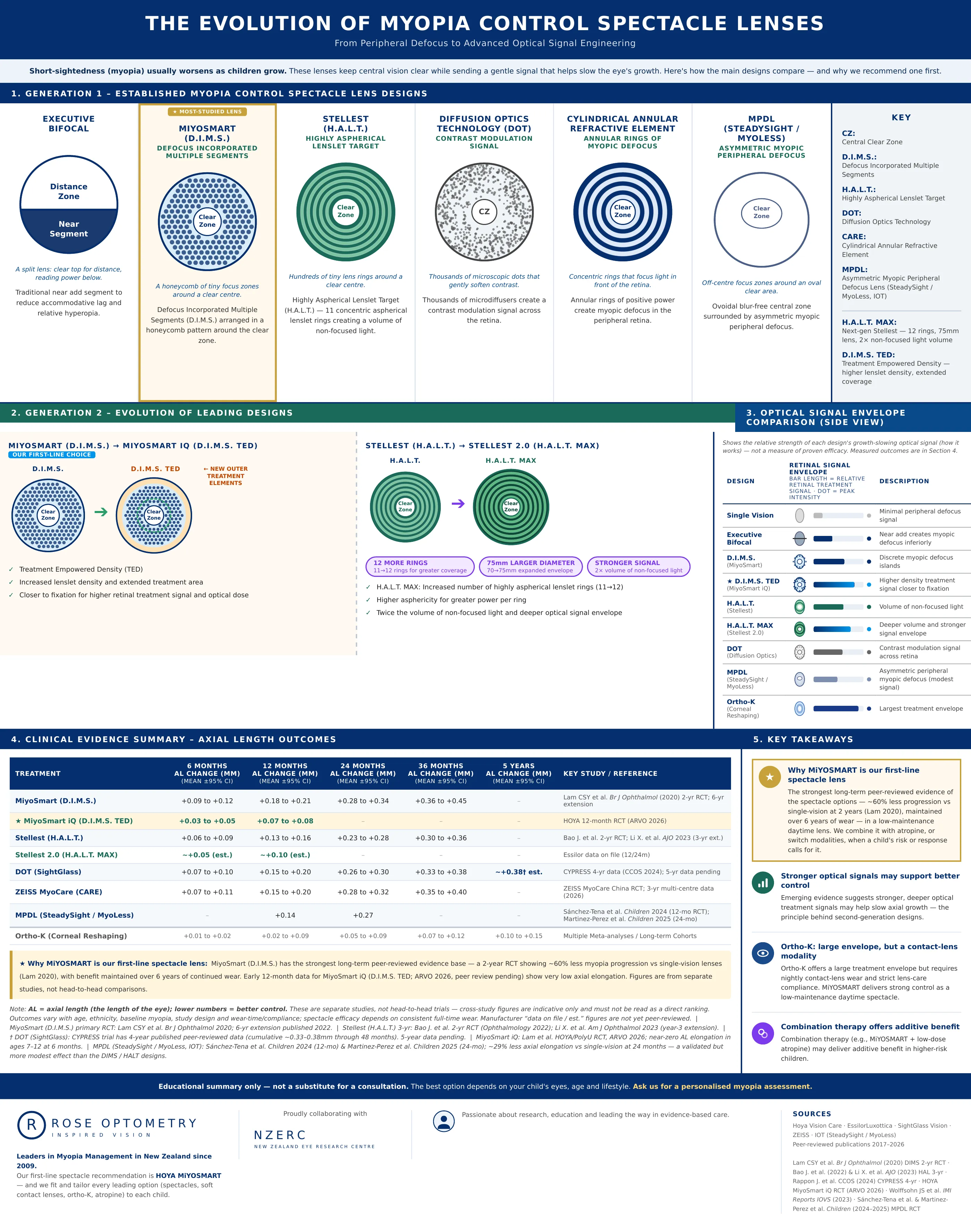
Myopia-control spectacle lenses
Modern myopia-control glasses look like ordinary lenses but are engineered to gently signal the eye to slow its growth, while keeping central vision sharp. They are our most common first step because they are effective, low-maintenance and suit almost any child.
Orthokeratology (overnight contact lenses)
Ortho-K lenses are worn only overnight. They gently reshape the front of the eye while your child sleeps, so they wake up seeing clearly all day with no glasses or daytime lenses — while also slowing eye growth (measured as axial length, never as a change in glasses prescription) by around 43% in the key randomised trial, with published studies ranging from 32% to 63%. They are popular with active children and teens who play sport or dislike glasses. Because they are contact lenses, good hygiene and regular check-ups matter, and we monitor every wearer closely to keep the small risk of eye infection low.
Daily soft contact lenses (MiSight & Acuvue Abiliti)
MiSight is a soft, daily-disposable contact lens designed specifically for myopia control. A fresh lens each morning, thrown away each night — no cleaning, and a low infection risk. In its clinical trials it slowed eye growth (axial length) by 52% and slowed prescription change by 59% over three years, with the benefit lasting into the teenage years.
We also fit Acuvue Abiliti 1-Day (Johnson & Johnson), a newer daily myopia-control lens that uses “RingBoost” optics. Its clinical data so far are company-reported rather than independently published in the peer-reviewed literature, so we will talk you through what is and is not yet independently established before weighing it alongside MiSight for your child.
Low-dose atropine eye drops
A single low-dose atropine drop at bedtime helps slow eye growth through the eye's own biology. Atropine for myopia is a prescription medicine, used under our supervision — in New Zealand, Eikance was the first atropine drop approved by Medsafe specifically for this purpose. Some children notice a little light sensitivity or slightly blurred near vision, which is why it is prescribed and monitored, and often managed with the right lenses. We frequently use atropine alongside glasses or contact lenses — combination therapy — for children whose myopia is progressing quickly, to gain more control than either approach alone.
Repeated low-level red-light therapy
One of the newest tools in myopia care, red-light therapy uses brief, comfortable daily sessions with a small device at home. In the key randomised trial, children who used the device at least 75% of the time as directed showed refraction progression slowed by 87.7% and axial elongation by 76.8% at that same compliance level — the effect is smaller (around 68–75%) when every enrolled child is counted regardless of how consistently they used it. Because it is new, we are honest about the limits: the trial's senior author holds a financial interest in the device manufacturer, the long-term safety data are still being gathered, and the effect can partly reverse if treatment stops. We use it selectively, with careful monitoring — including choroidal thickness tracking that can show within three months whether it is working for your child — and we will always talk you through what is known and not yet known before recommending it.
Ready to get started? Book your child's eye exam online — new to Rose Optometry or already our patient — or, if you'd like to talk it through first, book a free Myopia Chat.
How we build your child's myopia plan
What sets a dedicated myopia clinic apart is not just the range of treatments — it is the measurement and follow-through behind them. Every plan at Rose Optometry includes precisely measuring the actual length of your child's eye at each visit (called axial-length monitoring), so we can see whether a treatment is working and adjust early if it isn't. We combine treatments where the evidence supports it, review progress regularly, and involve you and your child in every decision.
If you want a serious, evidence-based answer to a prescription that keeps climbing — a clinic set up specifically to slow your child's short-sightedness and protect their long-term sight — that is exactly what ours was built to do.
Book your child's myopia assessment in Hamilton.
New to Rose Optometry? Book a New Child eye examination. Already with us? Book an Existing Child examination. Not sure where to start — or want to talk it through first? Book a free Myopia Chat, or call us on 07 847 3195.
This article is general information, not a substitute for a personalised assessment. Whether treatment is needed — and which option fits — depends on your child's eyes, age and lifestyle. Prescription treatments such as atropine are used only under professional supervision. For the science behind these treatments, see our companion article at the New Zealand Eye Research Centre.
References & key studies
Lam CSY, Tang WC, Tse DY, et al. Defocus Incorporated Multiple Segments (DIMS) spectacle lenses slow myopia progression: a 2-year randomised clinical trial. British Journal of Ophthalmology. 2020;104(3):363-368. PMID: 31142465.
Bao J, Huang Y, Li X, et al. Spectacle lenses with aspherical lenslets (Stellest / HAL) for myopia control: a 2-year randomised clinical trial. JAMA Ophthalmology. 2022;140(5):472-478. PMID: 35357402.
Chamberlain P, Peixoto-de-Matos SC, Logan NS, et al. A 3-year randomised clinical trial of MiSight dual-focus contact lenses for myopia control. Optometry and Vision Science. 2019;96(8):556-567. PMID: 31343513.
Johnson & Johnson Vision. ACUVUE Abiliti 1-Day (RingBoost technology) myopia-control clinical data; company-reported results, not yet independently peer-reviewed.
Cho P, Cheung SW. Retardation of Myopia in Orthokeratology (ROMIO): a 2-year randomised clinical trial. Investigative Ophthalmology & Visual Science. 2012;53(11):7077-7085. PMID: 22969068.
Hiraoka T. Myopia control with orthokeratology: a review. Eye & Contact Lens. 2022;48(3):100-104. PMID: 34860723.
Yam JC, Jiang Y, Tang SM, et al. Low-Concentration Atropine for Myopia Progression (LAMP) study. Ophthalmology. 2019;126(1):113-124. PMID: 30514630.
Jiang Y, Zhu Z, Tan X, et al. Effect of repeated low-level red-light therapy for myopia control in children: a randomised controlled trial. Ophthalmology. 2022;129(5):509-519. PMID: 34863776.
Bullimore MA, Brennan NA. Myopia control: why each dioptre matters. Optometry and Vision Science. 2019;96(6):463-465. PMID: 31116165.
Medsafe (New Zealand). Eikance (atropine sulfate) data sheet — approved to slow the progression of myopia, December 2023.
National Academies of Sciences, Engineering, and Medicine. Myopia: Causes, Prevention, and Treatment of an Increasingly Common Disease. 2024.
Recent articles
See things the Rose way
Make an appointment at Hamilton’s leading eye care specialists.

