Surfer's eye, batsman's eye: the condition three great batsmen played through
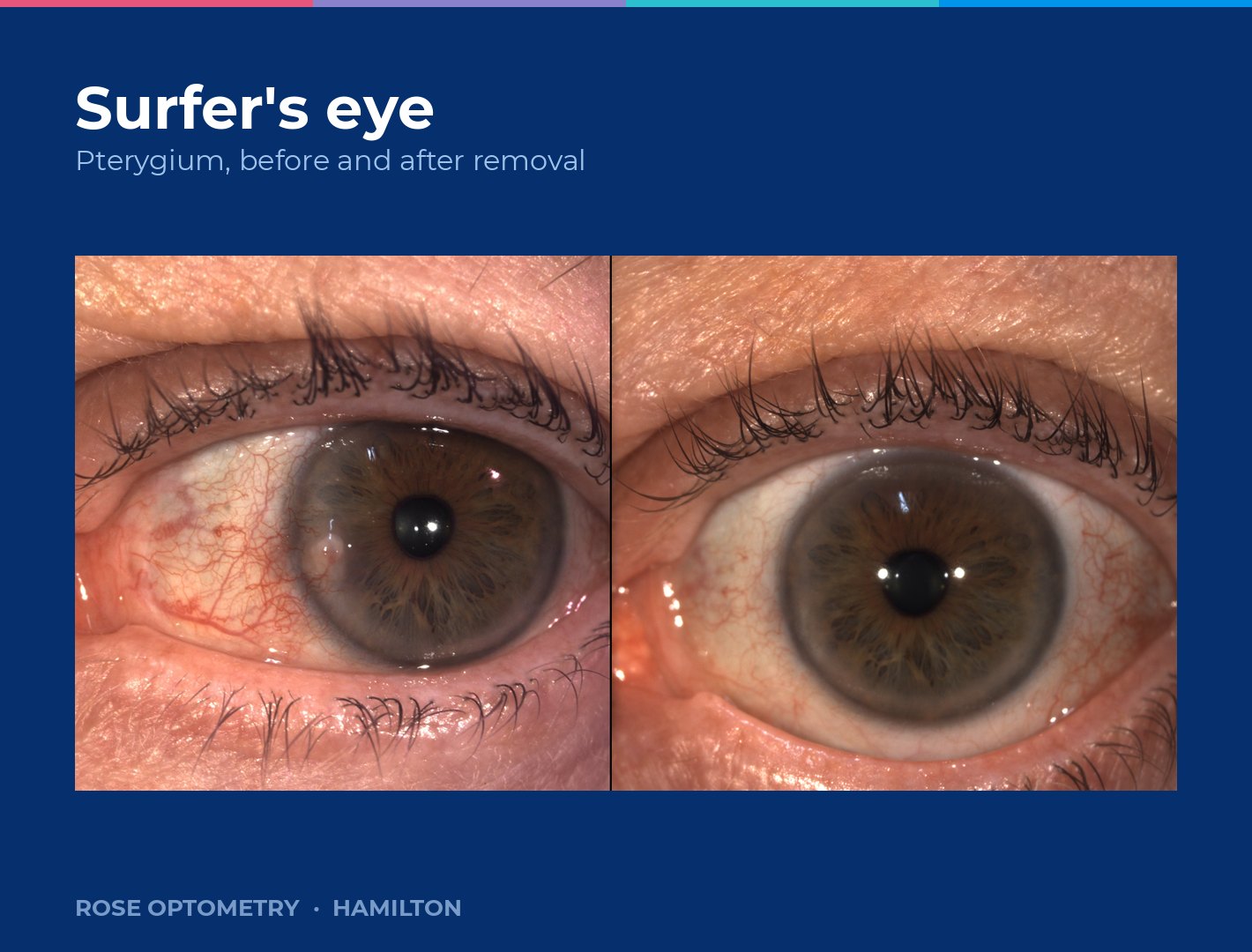
Somewhere in a Hamilton clinic room this month, a farmer, a builder, a keen surfcaster or a club cricketer will sit down at the slit lamp and hear a word they have never heard before. Pterygium. Pronounced te-RIJ-ee-um. It sounds exotic. It is not. In our chairs it is one of the most common findings on the front of the eye, and most people who have one had no idea it was there until someone shone a light on it.
The best way into it is not a diagram. It is a story about people who make their living with their eyes.
Ross Taylor: 20/20 vision, and he still couldn't see the ball swing
In November 2016, New Zealand's team physiotherapist Tommy Simsek confirmed publicly that Ross Taylor had a pterygium on his left eye, "which is gradually getting bigger." He had it removed in late November 2016, immediately after the second Test against Pakistan at Seddon Park in Hamilton — a Test in which he scored a century.
Two things there matter more than anything else in this article. He scored a Test century with it. Two specialists confirmed he still had 20/20 vision. And by his own account he had not been able to read swing for years.
"Seeing the ball swing from the hand, I hadn't been able to see that for two or three years."
"A lot of times in day-night games you didn't want the ball to come near you in the field."
"In hindsight it would have been nice to have the operation two or three years earlier."
A man with perfect measured acuity, at the peak of international sport, with a national team's entire medical apparatus behind him — and a slow-growing wedge of tissue on his eye quietly took away his ability to read swing for two or three years before anyone acted on it.
Taylor traces the symptoms back to the 2015 series in Australia. An optometrist in Brisbane gave him drops between Tests; the relief was immediate enough that he went out and made 290 at the WACA. "I couldn't really see the ball [before] so the eye drops obviously worked." He struggled particularly with the pink ball under lights in Adelaide — a background-contrast problem, which is exactly what an irregular tear film over a distorted cornea produces.
In 2017, the year after surgery, he averaged 81.60 in Tests and 60.50 in ODIs.
Being straight about the numbers. In 2016 — entirely before the surgery — Taylor averaged 60.60 in Tests with three centuries. In 2018, entirely after it, he averaged 23.08 in Tests, though 91.29 in ODIs that same year. Small samples, pointing in every direction at once. Taylor himself refuses to over-claim: "Has it made a big difference? It's hard to tell, you are older and wiser as well which makes a difference."
The lesson is not "surgery makes you bat better." The lesson is that 20/20 on a letter chart is not the same thing as seeing well, and a person can lose a great deal of real-world visual function while still reading the bottom line.
Brian Lara: "it feels like I've got grit in my eye"
In August 2000, during the West Indies tour of England, Brian Lara was reported to have a pterygium and was to see specialists after the fifth Test to decide on surgery. His description of it is the best patient-facing summary of the condition anyone has given:
"When it gets bad, it feels like I've got grit in my eye — that's the last thing you need in the middle of an innings."
"It doesn't affect my vision much but sometimes I do have trouble seeing the ball against certain backgrounds."
Grit in the eye. Trouble against certain backgrounds. Those symptoms have many causes and a pterygium is only one of them — but they are worth having looked at rather than living with.
Viv Richards, and what an average doesn't record
The third name is the one people half-remember, and it is also where we have to be careful.
In August 1991, Viv Richards batted in a Test for the last time, at The Oval. He needed 20 runs in that final innings to retire with a career average of 50. He made 60 off 105 balls, took three standing ovations, and finished on 8,540 runs at 50.23 from 121 Tests. Split that career at the end of 1983 and you get two different players: 55.49 before, 44.98 after.
It is often said that a pterygium and an operation sit somewhere in that gap. We went looking for the evidence, and here is all there is: in 2000, Brian Lara — facing the same diagnosis himself — told reporters, "Viv Richards had successful surgery for this condition so I will do what I am told by the specialists." One second-hand sentence. No date, no details, nothing from Richards himself.
So we are not going to build an argument on it. Richards was 32 in 1984 and 39 when he retired. Batsmen slow down; reflexes fade. Anyone who tells you a growth on his eye cost him a decade of runs is selling you something. Even the tidy "1984" story doesn't behave: he made 862 runs that year including a 208 against Australia — heavy volume, but at an average of about 45, already below the 55 of the years before.
What the story is actually good for is this. Averages measure runs. They do not measure how clearly a man could see the seam leave the hand at 90 miles an hour. Eyes are like that too. The damage accumulates in a column nobody is keeping.
The sports where it is not a coincidence
There is a temptation to compile a long celebrity list here. We are not going to, because when we went looking, the honest finding was that the roll call of publicly documented cases in world sport is remarkably short — essentially Taylor, Lara and Richards, and even then only because someone happened to ask.
That is not because athletes don't get pterygia. It is because nobody looks. The population data tells the real story, and it is far more damning than any list of names.
The Hawaii surfing study is the one to know. Researchers examined 169 people at four Oahu beaches and sorted them by lifetime hours spent surfing:
- Non-surfers — 2.3%
- Occasional surfers — 12.2%
- Recreational surfers — 20.0%
- Surfing enthusiasts — 36.0%
A clean dose-response curve, significant at p < 0.0001, with a trend towards larger lesions in those with more lifetime hours in the water — though the enthusiast group was only 25 people. More than a third of dedicated surfers had one.
The foundational study is older and even starker. In 1989, researchers examined 838 Chesapeake Bay watermen and reconstructed each man's lifetime UV dose from his occupational history. 16.7% had a pterygium. 76.6% had a pinguecula — the earlier, non-corneal cousin of the same disease.
On the Croatian island of Rab, a village population of 480 farmers and fishermen had a pterygium rate of 23%. Sixty-one urban residents on the same island were examined, and none had one. Same latitude. Same sun. Different jobs.
And a survey of 646 surfers at eight Victorian beaches found that among those reporting chronic health problems, pterygium was one of the three named categories — alongside surfer's ear and joint pain. It behaves like an occupational disease of the outdoors, even though it isn't formally recognised as one.
Cricket. Surfing. Sailing. Fishing. Farming. Golf. Building. Landscaping. Road crews. Anyone who reflects light off water, off concrete, off a paddock, or off the sea.
Sport has learned to protect skin. It has almost entirely ignored eyes.
A 2022 scoping review of sun protection in Australasian sport found that after four decades of Slip, Slop, Slap, "the use of sun-protection in most outdoor sports is inadequate." Only 14% of triathletes met combined recommendations. Among retired players at one NSW cricket club, 38.4% had been diagnosed with skin cancer. England's Sam Billings, who had a melanoma removed in 2022, put it plainly: "We treat it [applying suncream] like a bit of a chore, because the education around it isn't as good as in countries like Australia… I'd like to see everyone in cricket working together: the sun is out, so let's protect ourselves."
But when those reviewers went looking for data on sunglasses use in sport, they found almost none at all. The only group with near-universal eye protection was skiers and snowboarders.
We have taught a whole country to put a shirt on. We have not taught it to protect the one organ that has no melanin to fall back on.
So what is actually growing on your eye?
A pterygium is a wing-shaped growth of fibrous, blood-vessel-rich tissue that starts on the conjunctiva — the clear membrane over the white of the eye — and creeps onto the cornea. Under a microscope, the tissue shows solar elastotic degeneration: the same sun-damage signature a dermatologist sees in weathered skin. It is not a cancer. It is a scar the sun has been writing slowly.
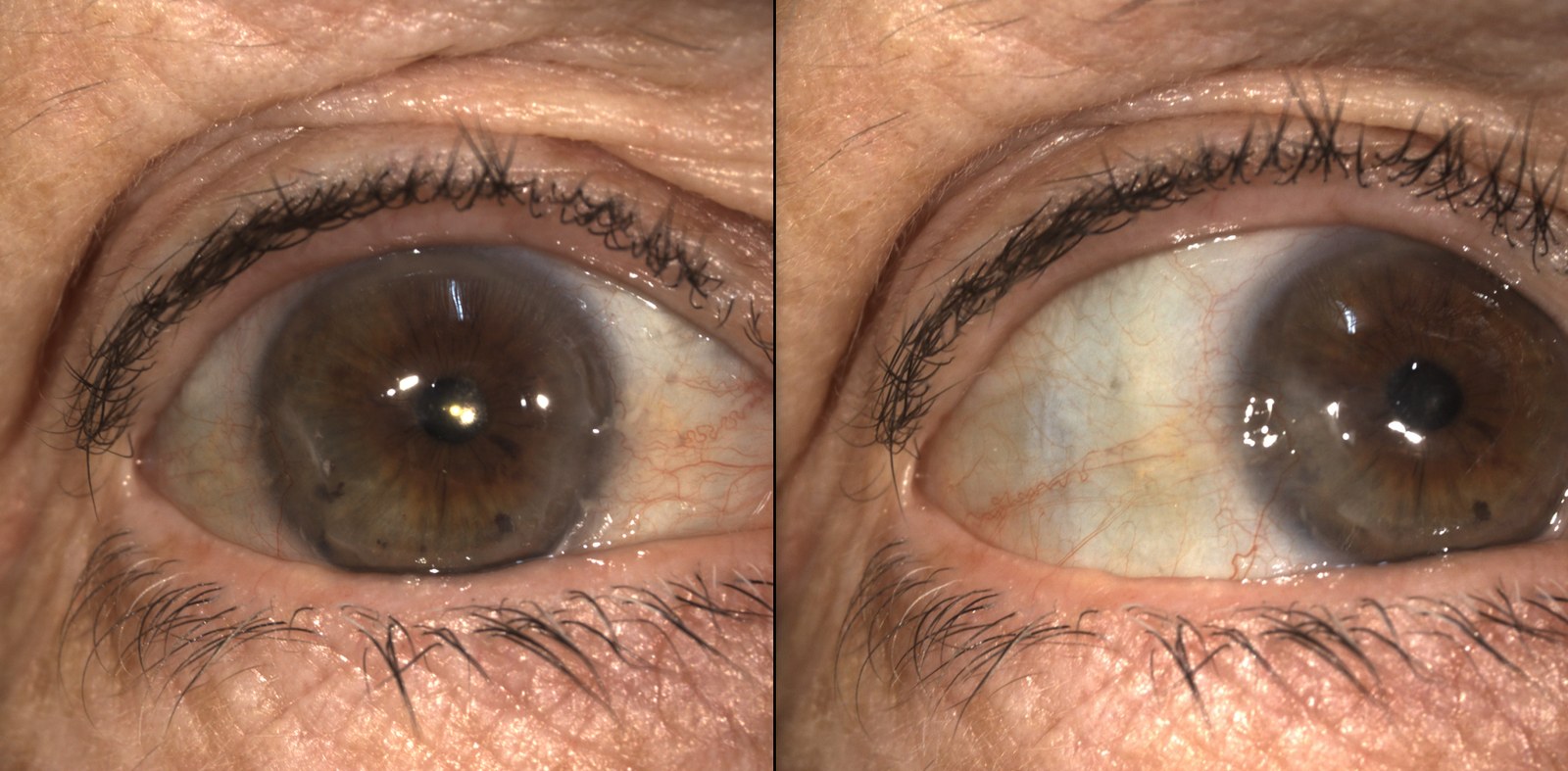
Its milder relative, a pinguecula, is the same degenerative change but stops at the edge of the cornea without invading it. Pinguecula is extremely common — nearly 70% of Australians aged 49 and over had one in the Blue Mountains Eye Study, and the rate rises with age. The single distinguishing feature between the two is corneal invasion.
Why nearly always on the nose side?
The classical explanation, proposed by Coroneo, is peripheral light focusing: light entering from the temporal side at a shallow angle is refracted by the cornea and concentrated onto the nasal limbus, where the stem cells that maintain the corneal surface live. It is a compelling theory and the one most textbooks give. In fairness, a 2020 optical reappraisal found the effect insufficient on its own to explain the nasal preference, and proposed that tear flow carrying inflammatory signals from temporal to nasal also plays a part. The mechanism is still argued about. The nasal predominance is not.
Globally, a 2026 modelling analysis of 103 studies covering 11.7 million participants estimated pterygium prevalence in 2023 at 8.22% among people aged 10–89 — roughly 553 million people. Prevalence climbs steadily with age, from 2.46% in the 10–19s to 19.43% in the 80s.
Why New Zealand eyes are in a category of their own
Pterygium is most common inside a band roughly 40° north and south of the equator. New Zealand spans about 34°S to 47°S — so the North Island sits inside that band, and Hamilton is close to its southern edge. Latitude alone would put us at moderate risk.
Our atmosphere puts us higher. Peak summer UV index in New Zealand is around 40% higher than at comparable northern-hemisphere latitudes. That figure comes from NIWA and it holds up. Three things drive it:
- Clean air. Southern-hemisphere skies carry far less industrial aerosol and dust, and NIWA researchers attribute a substantial share of the difference to this alone.
- Orbit. Earth is closer to the sun during our summer, adding several percent to peak UV compared with a northern summer.
- Ozone. Naturally lower southern ozone, plus historical depletion — summertime UV over New Zealand is 10–15% higher than it would have been in the 1970s.
Peak summer UVI here generally reaches about 12, and can exceed 13 in the far North. A UVI of 12 means a burn time of roughly twelve minutes.
One myth worth dispatching: this is not the Antarctic ozone hole. It sits more than 1,000km south of us and appears from August to October when our UV is naturally low. Our problem is everyday summer sun, a fair-skinned population, and an outdoor culture — not a hole in the sky.
We could not find a published prevalence figure for pterygium in New Zealand, and we are not going to invent one. What we can point to is Australian data. The Blue Mountains Eye Study (NSW, 3,564 people aged 49 and over) found pterygium in 7.3% — 11.0% of men, 4.5% of women. The Melbourne Visual Impairment Project (5,147 people aged 40 and over) found something even more instructive: 1.2% in urban Melbourne against 6.7% in rural Victoria, an odds ratio of 5.28 for rural residence.
Same state, and the study's own mechanism was lifetime ocular sun exposure rather than geography alone. It calculated the attributable risk of sunlight at 43.6%, and the World Health Organization's estimate is that between 42% and 74% of pterygium worldwide is attributable to solar radiation. That is the share of the risk that behaviour can act on. It is not a guarantee — no trial has ever shown that sunglasses prevent a pterygium from forming — but it is not nothing, either.
One further New Zealand note that deserves more attention than it gets: an analysis of national hospital discharge data identified pterygium as a previously unrecognised cause of excess morbidity among Pacific peoples in Aotearoa — an equity gap in an entirely treatable condition.
What it feels like, and why a vision test can miss it
The early symptoms are unglamorous and easy to dismiss:
- Persistent redness on one side of the eye, usually the nose side
- A gritty, foreign-body sensation — Lara's "grit in my eye"
- Dryness that drops don't quite fix
- Eyes that flare after a day outdoors, on the water, or in the wind
- Vision that fluctuates through the day, or that struggles against certain backgrounds
Notice that none of those are "I can't read the chart." Which brings us back to Ross Taylor's 20/20. Three separate things go wrong, and a letter chart reliably catches none of them.
Astigmatism
As the pterygium advances, its contractile tissue physically pulls on the cornea and flattens it along one meridian. Extension beyond 1.00mm onto the cornea produces around 1.00 dioptre of astigmatism. At about 2.25mm, it induces roughly 2 dioptres — a level that reviewers propose as the threshold for considering surgery. Once a lesion passes 45% of the corneal radius, or comes within 3.20mm of the visual axis, induced astigmatism rises sharply.
Higher-order aberrations
Beyond ordinary spectacle-correctable error, a pterygium introduces optical distortions — trefoil in particular — that no lens can correct. These are what degrade contrast and make a ball hard to pick up against a background while the letter chart stays perfect. Surgery reduces them but does not always eliminate them, and the literature is clear that early removal reduces the likelihood of significant residual aberrations.
Tear film breakdown
A 2024 study compared pterygium eyes to healthy controls and to diagnosed dry eye patients. On tear break-up time and tear meniscus height, pterygium eyes performed no differently from mild and moderate dry eye. On corneal staining they were worse than all three comparison groups, and upper-lid meibomian gland loss was significantly greater. A pterygium doesn't just sit there — it destabilises the entire tear film. That is why lubricants alone often underperform and why lid margin care matters alongside them.
Astigmatism, aberration and an unstable tear film, all from one lesion. Three ways to lose real vision while still reading 6/6.
What we do about it
Most pterygia are watched, not cut. If yours is small, quiet and stable, the right management is usually observation with photography and measurement at each visit so we can see genuine change rather than rely on memory, plus lubricants for comfort, attention to the meibomian glands, a short course of anti-inflammatory drops if it flares — prescribed and monitored, since topical steroids need intraocular pressure checks and are not something to keep using on repeat — and serious UV protection. We measure the extent onto the cornea and track your astigmatism over time. That trend line, more than any single reading, tells us whether we are watching or acting.
Referral for surgical removal is considered when the lesion is advancing toward the visual axis, when induced astigmatism is meaningfully degrading vision, when irritation won't settle with medical treatment, when eye movement becomes restricted, or — legitimately — when the appearance is causing genuine distress.
On surgery, the honest picture is this: technique matters enormously, and recurrence is the central issue. The old "bare sclera" approach — simply excising the tissue and leaving the sclera exposed — has published recurrence rates from 24% to 89%. It has been superseded for good reason. Modern grafting techniques, in which conjunctival tissue from under the upper lid is transplanted to cover the bed, do far better. Pooled recurrence rates from a 30-year review:
- Bare sclera excision (superseded) — 24–89%
- Amniotic membrane graft — ~9.0%
- Conjunctival autograft — ~7.6%
- Limbal conjunctival autograft — ~5.5%
- Combined autograft + amniotic membrane — ~1.8%
These are ranges from the literature, not a promise about your eye. Recurrence depends on technique, on surgeon, on whether the pterygium is primary or already recurrent, on how fleshy and vascular it is, and on how long the study followed patients. What is worth knowing as a patient is that about half of recurrences appear within the first four months and around 97% within the first year — which is why follow-up runs for a full twelve months, and why UV protection matters most in exactly the period when discipline tends to slip.
Across the published literature, astigmatism usually falls after excision — 22 of 23 studies in one systematic review found a decrease, in one series from 3.8D down to 1.0D. But surgery does not always return the cornea to where it started, which is the argument for not waiting until a lesion reaches the pupil.
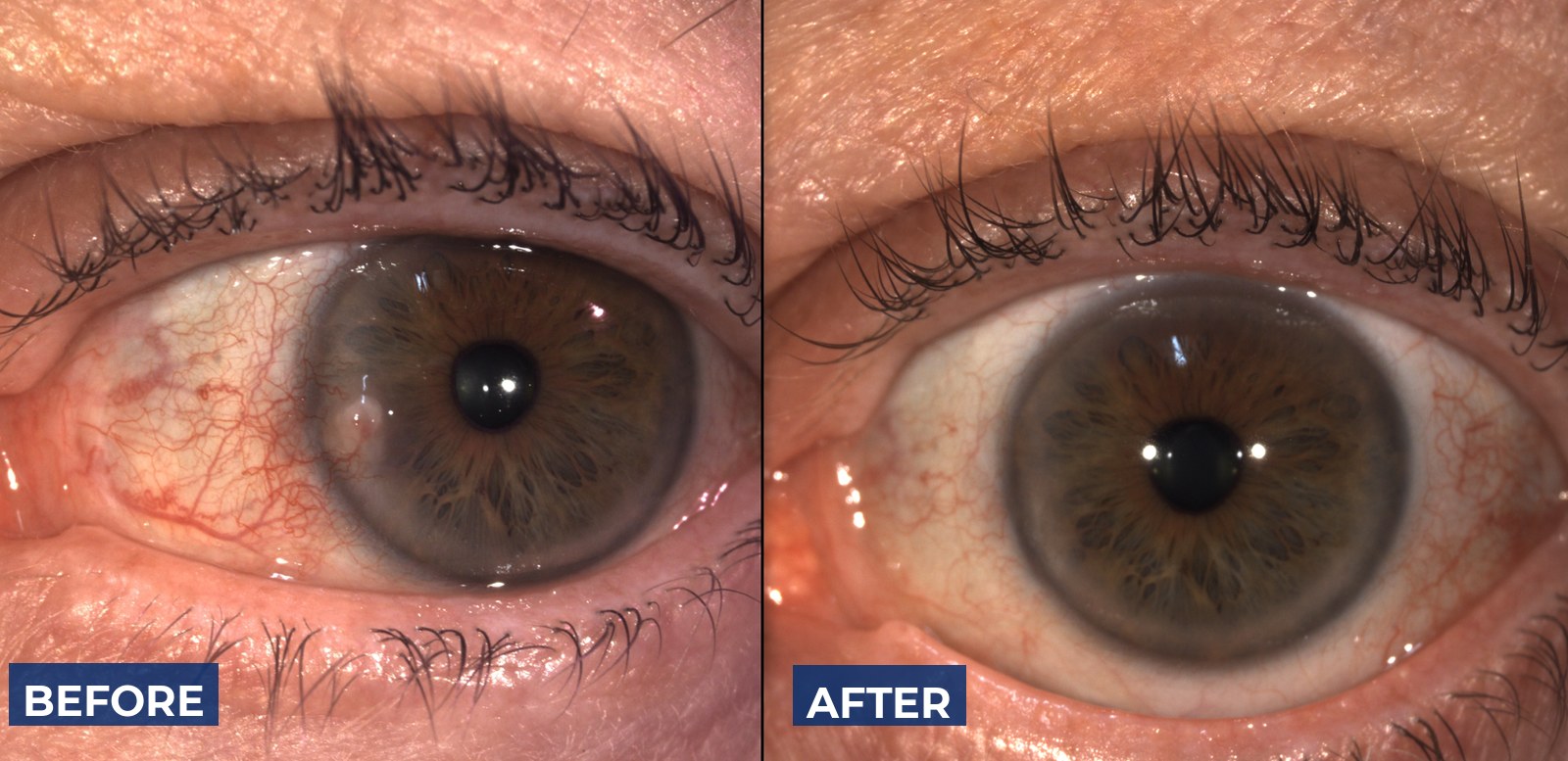
The counterweight, and it is a real one: a recurrence is usually worse than the original — fleshier, more inflamed and harder to treat — which is why nobody operates on a quiet pterygium just to be safe. The decision is a balance, and it is made with the surgeon.
Who we refer to in Hamilton
We don't do this surgery ourselves — pterygium excision is an ophthalmologist's job. What we do is work out whether you need it, get you to the right person, and look after you afterwards. We are not precious about where you go. These are the Hamilton practices that perform pterygium surgery:
- Hamilton Eye Clinic — Bridgewater Building, 130 Grantham Street, Hamilton 3204 · 07 834 0006. Also clinics in Huntly, Matamata, Morrinsville, Cambridge and Thames.
- Eye Surgeons — Anglesea Medical Centre, 13 Thackeray Street, Hamilton, and 7/1913 Cambridge Road, Cambridge 3434 · 07 242 0977. A/Prof James McKelvie is a cornea and anterior segment subspecialist and Clinical Director of the New Zealand National Eye Bank.
- Mr Chris Murphy, Flagstaff Eye Care — 1158 River Road, Flagstaff, Hamilton 3210 · 07 957 2758. Cornea, anterior segment and external disease. Also clinics in Thames, Paeroa and Whitianga.
That is not the complete list of ophthalmologists in Hamilton, and it isn't meant to be — these are simply the services we most often refer pterygium to. If you already have an ophthalmologist you trust, we will write to them instead. If you don't, we will suggest whoever suits the lesion and the timeframe, and tell you why we've suggested them.
The public pathway
Health New Zealand's position is that pterygium surgery "is usually done privately (you may need to pay) but if it is severe, it may be publicly funded." In practice the public threshold is high. Funding generally requires significant encroachment onto the cornea, a measurable effect on vision, or an appearance atypical enough to warrant investigating in its own right. A comfortable pterygium that hasn't reached far onto the cornea will not meet it.
How we refer. Where a case is worth putting forward, we send it electronically through CatTrax, the eReferral system used across the Waikato — developed, as it happens, here in the region by A/Prof James McKelvie. The referral goes to the hospital eye service with our measurements, our photographs and the history attached, rather than being retyped out of a letter.
That matters more than it sounds. Triage decisions get made on what is actually in front of the person reading them, and a referral carrying serial photographs that show genuine growth over two years is a very different proposition from one that says "pterygium, please review."
And if you won't meet the threshold, we will say so. There is no kindness in sending someone off to wait months for a decline. If your pterygium is unlikely to be accepted publicly, we will tell you plainly, explain what would need to change for that to be worth revisiting, and set out what the private route involves so you can decide with the actual numbers in hand.
Cost, privately
Published Waikato pricing sits in the region of $3,500 to $5,000 per eye, and quotes differ in what they include — surgeon's fee, facility fee, grafting materials and follow-up are not always bundled the same way. Ask for a written quote. If you have health insurance, seek prior approval before booking; cover is not automatic.
The one that isn't a pterygium
A small but important caution, and the reason we take photographs. A review of 2,061 specimens removed as clinically diagnosed pterygium found co-existing ocular surface squamous neoplasia in 0.6% — and in half of those, there had been no pre-operative suspicion at all. An Australian surfer, Erin Campbell, had what everyone assumed was surfer's eye; it was a conjunctival squamous cell carcinoma.
We have seen it here too.
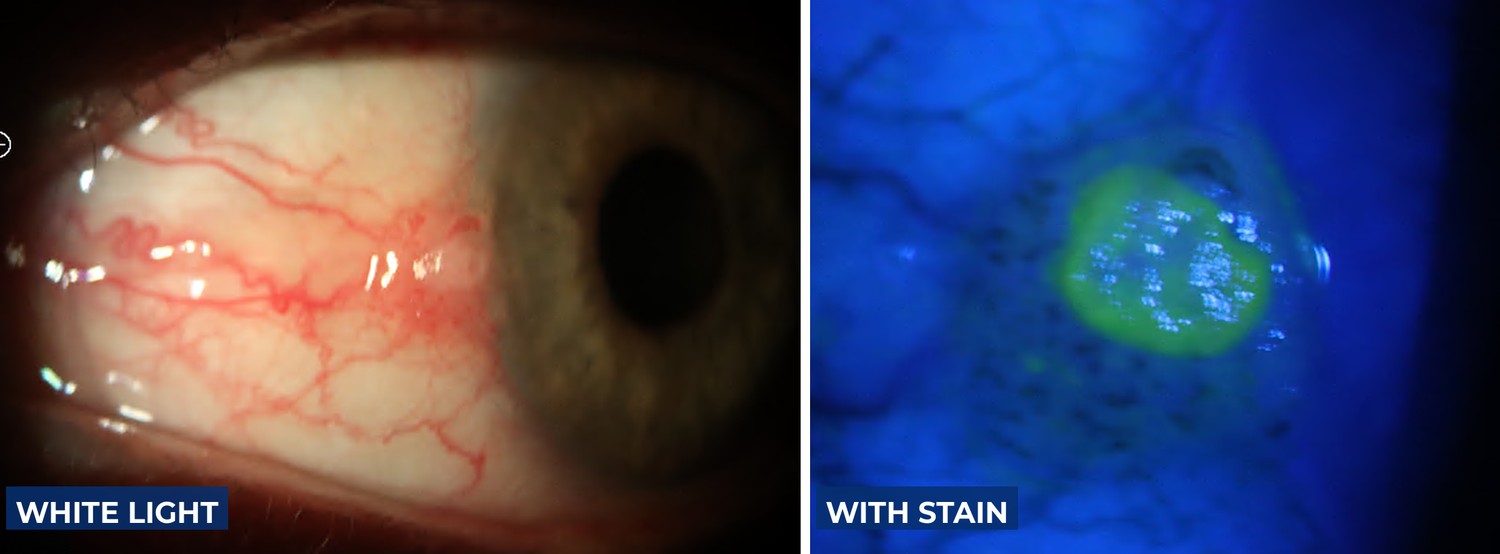
0.6% is low. It is not zero. Fine scattered brown pigment, unusual vascularity, a gelatinous or nodular appearance, or a lesion behaving differently from the textbook are all reasons to look harder. Any growth on the eye that is changing deserves an examination, not a guess.
What actually protects your eyes
Wrap around is not a style question. It is the part most people get wrong. RANZCO is explicit: "Non-wraparound sunglasses are not effective in blocking peripheral UV." Remember the peripheral light focusing story — the damaging rays arrive from the side, at a shallow angle, which is precisely the gap an ordinary frame leaves open.
A hat is not enough on its own. RANZCO puts the reduction in ocular UV from a broad-brimmed hat at around 50% — but that is the UV coming from above. Modelling of ocular UV dose found that diffuse, scattered sky radiation alone accounts for 51–78% of the total dose reaching the eye on a clear summer day; over snow, reflected radiation adds a third to a half again. Water, sand and concrete throw it straight back up under the brim. UV rises about 10% per 1,000 metres of altitude. Thin cloud does almost nothing and can increase UV through scattering.
Look for the standard, not the tint. Sunglasses sold in New Zealand should meet AS/NZS 1067, categories 2, 3 or 4. UV400 labelling indicates full UV blocking. Critically, lens darkness tells you nothing about UV protection — and there is evidence that dark lenses with poor UV filtering may be worse than no sunglasses at all, because the tint removes your natural protective squint and opens your field of view to unfiltered light while the eye behaves as though it is in shade.
Practical version, for a New Zealand summer
- Wraparound, close-fitting sunglasses to AS/NZS 1067, from September through April, and hardest between 10am and 4pm
- A broad-brimmed hat as well as, never instead of
- Sunglasses on the water, on snow, and on light-coloured surfaces even under cloud
- Children too — a great deal of lifetime ocular UV dose is accumulated before adulthood
- UV-blocking contact lenses have been shown in measurement studies to cut the UV reaching the limbus. They have not been shown to prevent pterygium, they do not cover the rest of the conjunctiva, and they are an adjunct to sunglasses, never a replacement
- After pterygium surgery, treat UV protection as part of the treatment
Frequently asked
Is a pterygium cancer?
No. It is a benign, sun-driven degenerative growth. That said, a small proportion of lesions that look like pterygium turn out to be something else, which is why any changing growth on the eye should be examined properly.
Will it go away on its own?
No. Pterygia do not regress spontaneously. They may stay quiet for years, and many never need surgery — but they don't disappear.
Can drops shrink it?
No. Lubricants and anti-inflammatory drops treat the symptoms — grittiness, redness, dryness — and they are often all that is needed. They do not remove the tissue.
Does it always need surgery?
No. Many pterygia are simply monitored for life. The decision to operate rests on growth toward the visual axis, induced astigmatism, persistent inflammation, restricted eye movement, or appearance.
Can it come back after surgery?
Yes, and this is the main reason technique matters. Published recurrence rates vary widely — from very high with the outdated bare sclera method to low single figures with modern grafting. Most recurrences appear within the first year, and about half within four months, which is why follow-up and post-operative UV protection matter.
I have 20/20 vision. Can it still be affecting me?
Yes — and Ross Taylor is the case in point. Acuity charts measure high-contrast letters in ideal light. They do not measure contrast sensitivity, higher-order aberration, or tear film stability, all of which a pterygium disturbs.
Can I get it in both eyes?
Often, yes. Bilateral pterygium is common in people with heavy cumulative sun exposure.
Is it hereditary?
There is a familial component, but the dominant driver is cumulative ultraviolet exposure — which is the part you can act on.
Do I need a referral to see an ophthalmologist?
Most Hamilton practices accept referrals from optometrists as well as GPs, and several accept self-referral. If we think you need a surgical opinion we will write the referral, include the measurements and photographs, and tell you what we've asked for. Public referrals go through the CatTrax eReferral system.
Get it looked at
If you have a growth, a persistently red patch on the nose side of the eye, or that gritty feeling that never quite settles — or if you spend your days on a farm, a boat, a building site, a golf course or in the surf — book an examination.
At Rose Optometry we examine the ocular surface at the slit lamp, photograph and measure any lesion so change can be tracked objectively rather than from memory, assess the tear film and meibomian glands, measure induced astigmatism, and manage symptoms medically. Where a lesion is advancing or vision is being affected, we arrange ophthalmology referral and co-manage the post-operative care.
Whatever we find, you will get a clear explanation of what it is, what it is doing, and whether it needs anything done about it now.
Rose Optometry · 38 Lake Road, Frankton, Hamilton 3204 · 07 847 3195 · info@roseoptom.co.nz
This article is general information about an eye condition and is not a diagnosis or a substitute for an examination. If you are concerned about your eyes, please book an appointment.
References
Shan S et al. J Glob Health 2026;16:04271 · Zhou WP et al. Ophthalmic Epidemiol 2016;23(4) · Taylor HR et al. Arch Ophthalmol 1989;107(10) · Taylor DM et al. J Sci Med Sport 2004;7(4) · Vojnikovic B et al. Coll Antropol 2007 · Modenese A, Gobba F. IJERPH 2018;15:37 · McCarty CA et al. Br J Ophthalmol 2000;84(3):289 · Panchapakesan J et al. Blue Mountains Eye Study · Liu L et al. BMJ Open 2013;3:e003787 · Korean J Ophthalmol 2025 · Ther Adv Ophthalmol 2021 · Ophthalmol Ther 2023 · Hirst LW et al. Ophthalmology 1994 · J Ophthalmic Inflamm Infect 2024 · Morton SK, Harrison SL. Curr Oncol 2022;30(1):401–415 · J Expo Sci Environ Epidemiol 2018 · RANZCO Position Statement on UV Eye Protection 2021 · NIWA UV and Ozone · SunSmart NZ 2025 · Eye 2023 · Sopoaga F et al. J Prim Health Care 2010 · Health New Zealand, Pterygium and pinguecula · ESPNcricinfo · Sky Sports 23 Nov 2016 · Mail & Guardian 18 Aug 2000.

Recent articles
See things the Rose way
Make an appointment at Hamilton’s leading eye care specialists.

