The New Zealand Eye Research Centre: a dedicated clinical trials site in Hamilton
The New Zealand Eye Research Centre operates from Rose Optometry in Frankton, Hamilton. It is not a room borrowed from clinic when a study arrives. Three rooms are equipped and reserved for research, alongside three fully instrumented optometrist rooms, and the site runs continuously rather than standing up for each protocol.
That distinction matters to a sponsor. A site that reconfigures itself for every study spends the first three months of recruitment learning how to run it. A standing site does not.
Why the research is held separately
The separation runs the other way too, and it is deliberate. Rose Optometry is a clinical practice, not a research site. Patients travel to Frankton from across New Zealand — and in some cases from overseas — for specialist care, and other optometrists refer to us weekly for co-management. Holding the research in a separate entity is what protects that. Trial protocols, monitoring visits and source data verification happen in the research rooms and on the research centre's time; they do not reshape a patient's appointment.
A sponsor should read that as stability. The site's income and its clinical reputation do not depend on any one study, so recruitment pressure never competes with patient care.
Instrumentation
A full serial-numbered inventory is available on request. In summary, by capability:
Anterior segment and cornea. Heidelberg ANTERION swept-source OCT, giving tomography, full pachymetry, epithelial thickness mapping and SCORE ectasia analysis. Six Medmont Meridia and E300 topographers. TOMEY EM-4000 specular microscope. Scheimpflug analysis via Pentacam AXL Wave and Scansys TA617 on project access.
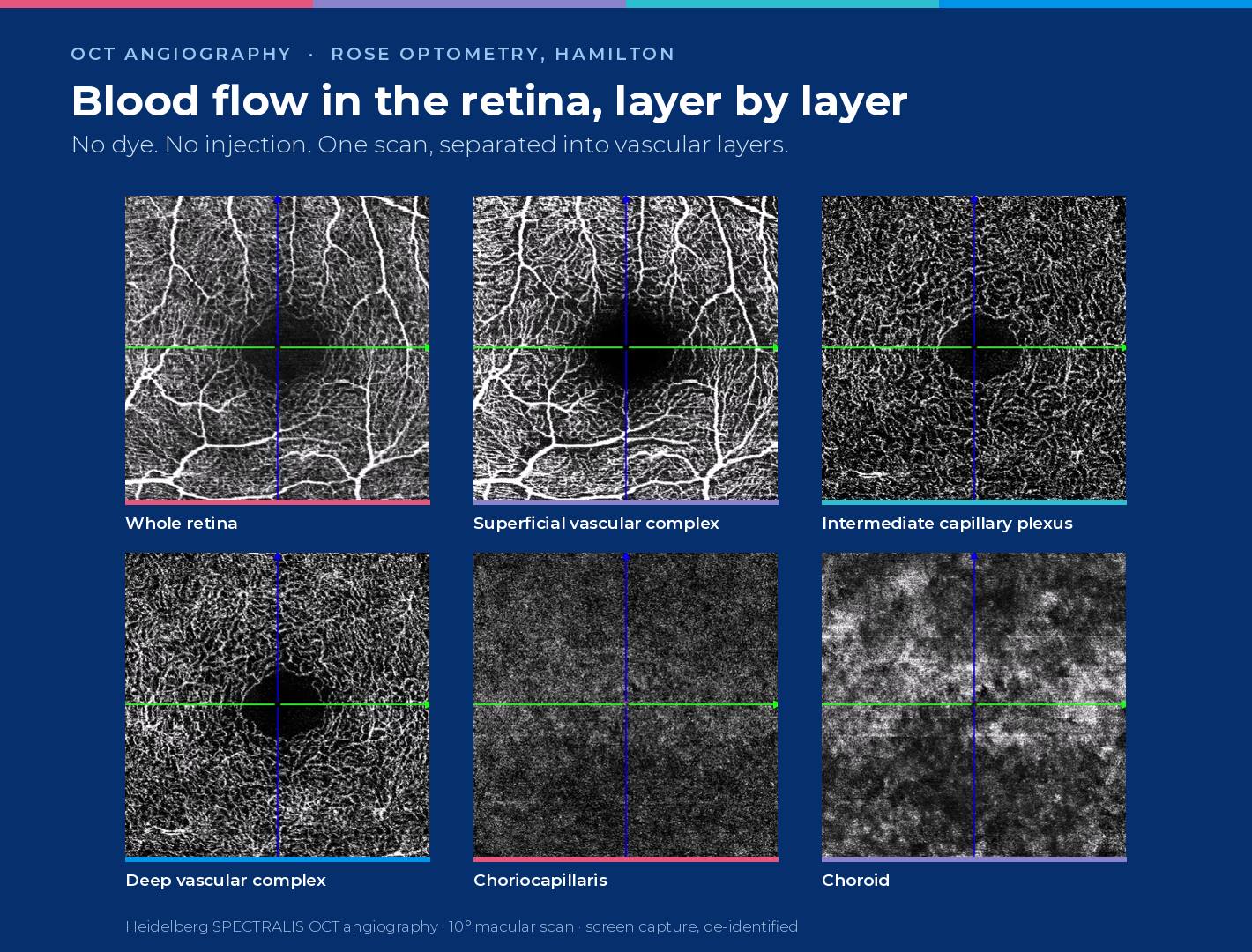
Retina and optic nerve. Heidelberg Spectralis OCT with the Nsite Analytics neurodegeneration module, BluePeak blue-laser autofluorescence, scanning laser angiography, and AppWay applications including NMI-ChoroidAI for automated three-dimensional choroidal segmentation. TOPCON NW500 non-mydriatic retinal camera.
Perimetry. ZEISS Humphrey Field Analyzer 800 and Humphrey Matrix FDT.
Biometry. ZEISS IOL Master and NIDEK AL-Scan — two independent optical biometers, so axial length can be cross-checked rather than trusted to a single instrument.
Tonometry. iCare ic100 and NIDEK TONOREF.
Ocular surface. E-SWIN TearCheck and Trukera ScoutPro osmolarity for assessment; E-SWIN E>Eye IRPL, LipiFlow thermal pulsation, Théa Blephasteam, Novoxel Tixel 2 and Rexon-Eye quantum molecular resonance for treatment.
Acuity to trial standard. GOOD-LITE ETDRS illuminated cabinets and chart sets, and NIDEK digital charts — so an acuity measured here is comparable with an acuity measured in an international trial.
Therapeutic areas
Keratoconus and corneal ectasia. Myopia control in children. Dry eye and ocular surface disease. Glaucoma monitoring. Macular disease, including photobiomodulation. Specialty and scleral contact lens design.
Population access
New Zealand's keratoconus epidemiology is not the same as the populations most screening thresholds were derived from. The Aotearoa Research into Keratoconus study found Māori and Pacific peoples over-represented and more severely affected, and a Wellington school screening study found keratoconus in roughly 1 in 45 Māori students against 1 in 190 overall.
For a sponsor, that is both a recruitment advantage and a regulatory one: it gives access to a population that is genuinely under-represented in the published evidence, in a country with a single national health system, English-language consent, and ICH-GCP-aligned ethics review.
Investigator-initiated questions
We are actively interested in collaborators on several questions our own data raises. Whether corneal ectasia screening cut-offs derived in other populations transfer to New Zealand eyes — the published validation of the ANTERION SCORE, for instance, was carried out in a Korean cohort. Whether choroidal thickness measured on OCT can serve as an early response marker in myopia management for practices without access to biometry. And the long-term axial length outcomes of customised myopia control plans, on which we now hold seventeen years of measurements.
Working with us
We are glad to complete site-selection questionnaires, provide the full serial-numbered equipment inventory with calibration records, and discuss feasibility for a specific protocol. Please contact us at info@roseoptom.co.nz or on 07 847 3195.
Enquiries from optometrists and ophthalmologists about co-management or collaboration are equally welcome. There are more patients in this country who need this kind of assessment than any one practice can look after.
Recent articles
See things the Rose way
Make an appointment at Hamilton’s leading eye care specialists.

