Lazy Eye (Amblyopia) in Children: Signs, Treatment and Whether It Can Be Fixed Later
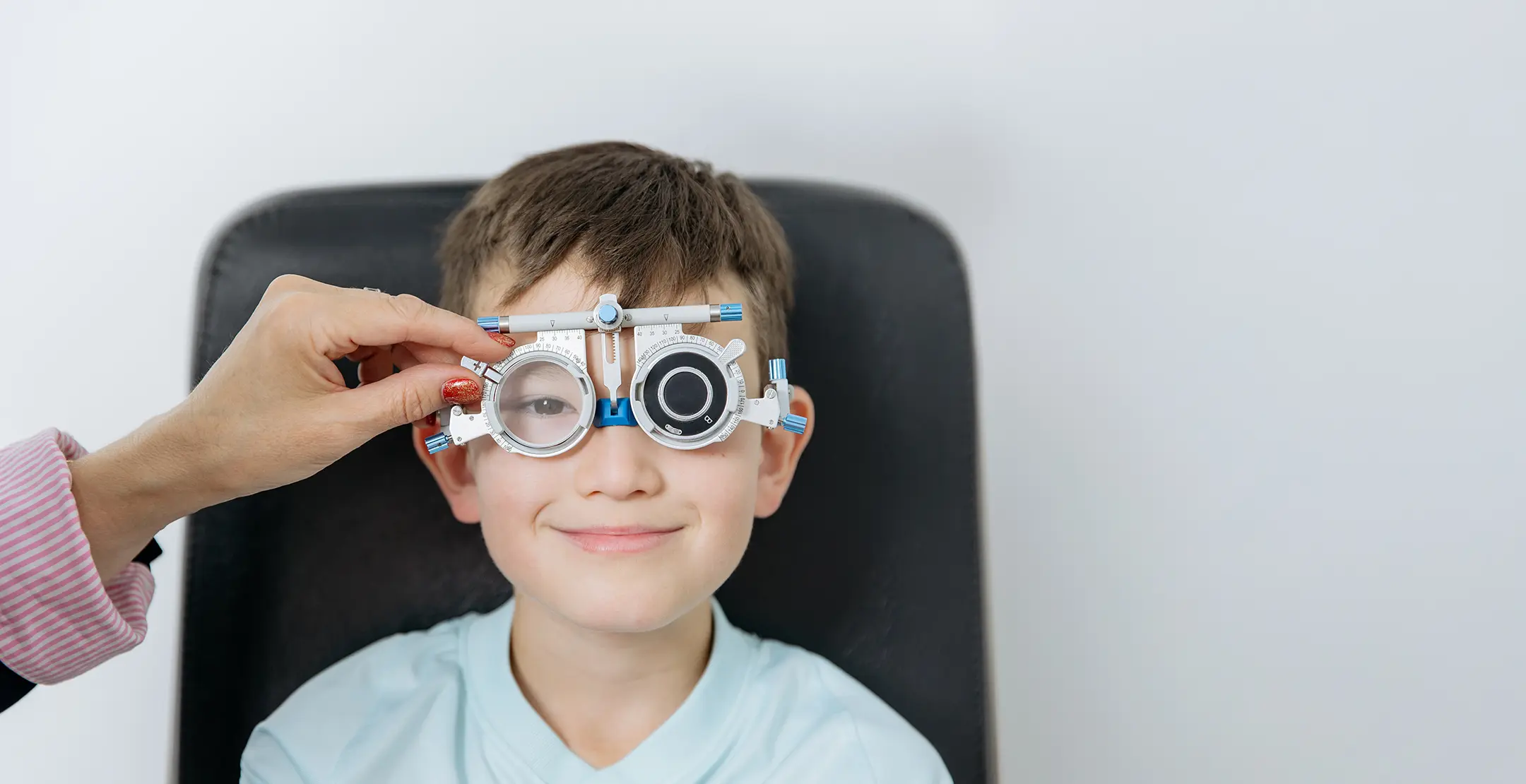
A lazy eye (amblyopia) is reduced vision in one eye because the brain and that eye did not learn to work together properly in early childhood, usually because of a squint or a big focus difference between the eyes. It often has no obvious signs. Glasses, then patching or atropine drops, can improve it, and results are best before about age 7 [9].
This guide is written by the optometrist team at Rose Optometry in Hamilton: Jagrut Lallu, Jacqueline Rowe, Emilie Lawson, Jason Shen and Stella Wong. All of our optometrists examine children from six weeks of age, and children's vision is a particular interest of Emilie, Jagrut and Jason, and Stella has a special interest in binocular vision. It covers what parents most often ask us, and what the clinical trials actually show.
What is a lazy eye?
Amblyopia means one eye (occasionally both) does not see clearly even with the right glasses, because the visual pathway between that eye and the brain did not develop normally while the child was young [10].
It is common. A 2022 meta-analysis of 97 studies covering more than 4.6 million children estimated a worldwide prevalence of 1.36%, or roughly 1 to 2 children in every 100 [1]. A large Californian study of Asian and non-Hispanic white preschool children found 1.81% [2].
What causes a lazy eye?
About 90% of cases are reported to be caused by a squint, unequal focus between the eyes, or both [1]:
- A squint (strabismus): one eye turns in, out, up or down, so the two eyes are not looking at the same thing.
- Unequal focus (anisometropia): one eye is much more long-sighted, short-sighted or astigmatic than the other, so it sends a blurrier image.
Less common causes exist, which is one reason any child with reduced vision in one eye needs a full examination.
How do you know if your child has a lazy eye?
Often you can't. When the cause is unequal focus, the eyes look normal and the child does not complain, because the other eye sees well. Signs worth booking an eye examination for include:
- An eye that wanders or turns, all the time or when tired
- Squinting, tilting the head or closing one eye to look at things
- A parent or sibling who had a squint or lazy eye
Because many lazy eyes show none of these signs, a full children's eye examination, which includes checking each eye separately and measuring focus with drops where needed, is the reliable way to find it.
Can a lazy eye be corrected?
Often, yes, especially when it is found early. Treatment usually happens in steps, and most of the evidence comes from large studies, many of them randomised trials, run by the US Pediatric Eye Disease Investigator Group (PEDIG).
- Glasses first. Correcting the focus is the first treatment, and it is given time to work, up to about 6 months [10]. In 84 children aged 3 to 6 with untreated amblyopia from unequal focus, glasses alone improved vision by 2 or more lines in 77% and resolved the lazy eye in 27%, with improvement taking up to 30 weeks [3]. For some children, glasses are all that is needed. See our guide to kids' glasses in NZ.
- Patching, if vision is still reduced. Covering the stronger eye makes the brain use the lazy one. For moderate amblyopia, 2 hours a day worked as well as 6 hours: vision improved by an average of 2.40 lines in both groups over 4 months [4]. For severe amblyopia, 6 hours a day worked as well as full-time patching [5]. In children whose vision had stopped improving with glasses, adding 2 hours of daily patching gave more improvement than glasses alone (2.2 vs 1.3 lines) [6].
- Atropine drops, an alternative to patching. A drop in the stronger eye blurs its near vision so the lazy eye does more work. In 419 children with moderate amblyopia, patching and atropine gave similar results at 6 months (3.16 vs 2.84 lines). Patching worked a little faster at first, and parents rated the drops slightly more acceptable [7].
Your optometrist sets the plan, including how many hours of patching or how often to use drops, and reviews progress regularly.
What about newer digital treatments?
Dichoptic treatments show each eye a slightly different image, for example through a headset playing video. In a 12-week trial of 105 children aged 4 to 7, one such treatment used with glasses improved vision by 1.8 lines, compared with 0.8 lines for glasses alone [8]. The trial was short, run by the manufacturer and stopped early, and it did not compare the treatment with patching, so it is not yet known whether it works as well as patching.
Is it too late to treat a lazy eye after age 7?
Not necessarily, but results are smaller. Across four PEDIG trials of 996 children, those aged 7 to 12 responded significantly less than children under 7, although some older children showed a marked response [9]. In a trial of 507 children aged 7 to 17, 53% of 7 to 12 year olds responded to patching plus atropine (with glasses), compared with 25% with glasses alone. In 13 to 17 year olds there was no overall benefit, but teenagers who had never been treated before did better (47% vs 20%) [11]. Most children who improved were still left with some reduced vision in that eye [11].
That is why early checks matter, and why it is still worth an assessment for an older child or teenager who has never been treated.
Can a lazy eye come back after treatment?
Yes. In a study of 145 children who had been treated successfully, about 1 in 4 (24%) lost some vision again within a year of stopping [12]. In children on 6 or more hours of daily patching, recurrence was less common when patching was cut back to 2 hours a day before stopping than when it stopped suddenly, although that finding came from small groups and needs confirming [12]. Follow-up visits after treatment ends are part of the plan.
Lazy eye checks for children in Hamilton
If you notice an eye turning, or your child has a family history of squint or lazy eye, book a children's eye examination. For a new turn in the eye that appears suddenly, call us first on 07 847 3195 so we can see your child promptly.
- Book a children's eye examination (new patient)
- Book a children's eye examination (existing patient)
Read more about amblyopia at Rose Optometry, how to choose a children's optometrist in Hamilton, and, if your child is also short-sighted, myopia control for children.
Last reviewed 17 November 2026 by the Rose Optometry optometrist team, 38 Lake Road, Frankton, Hamilton. This article is general information and does not replace an eye examination.
References
- Hu B, et al. The global prevalence of amblyopia in children: a systematic review and meta-analysis. Front Pediatr. 2022;10:819998. PMID 35601430. doi:10.3389/fped.2022.819998
- McKean-Cowdin R, et al. Prevalence of amblyopia or strabismus in Asian and non-Hispanic white preschool children: Multi-Ethnic Pediatric Eye Disease Study. Ophthalmology. 2013;120(10):2117-24. PMID 23697956. doi:10.1016/j.ophtha.2013.03.001
- Cotter SA, et al. Treatment of anisometropic amblyopia in children with refractive correction. Ophthalmology. 2006;113(6):895-903. PMID 16751032. doi:10.1016/j.ophtha.2006.01.068
- Repka MX, et al. A randomized trial of patching regimens for treatment of moderate amblyopia in children. Arch Ophthalmol. 2003;121(5):603-11. PMID 12742836. doi:10.1001/archopht.121.5.603
- Holmes JM, et al. A randomized trial of prescribed patching regimens for treatment of severe amblyopia in children. Ophthalmology. 2003;110(11):2075-87. PMID 14597512. doi:10.1016/j.ophtha.2003.08.001
- Wallace DK, et al. A randomized trial to evaluate 2 hours of daily patching for strabismic and anisometropic amblyopia in children. Ophthalmology. 2006;113(6):904-12. PMID 16751033. doi:10.1016/j.ophtha.2006.01.069
- Pediatric Eye Disease Investigator Group. A randomized trial of atropine vs. patching for treatment of moderate amblyopia in children. Arch Ophthalmol. 2002;120(3):268-78. PMID 11879129. doi:10.1001/archopht.120.3.268
- Xiao S, et al. Randomized controlled trial of a dichoptic digital therapeutic for amblyopia. Ophthalmology. 2022;129(1):77-85. PMID 34534556. doi:10.1016/j.ophtha.2021.09.001
- Holmes JM, et al. Effect of age on response to amblyopia treatment in children. Arch Ophthalmol. 2011;129(11):1451-7. PMID 21746970. doi:10.1001/archophthalmol.2011.179
- Holmes JM, Clarke MP. Amblyopia. Lancet. 2006;367(9519):1343-51. PMID 16631913. doi:10.1016/S0140-6736(06)68581-4
- Scheiman MM, et al. Randomized trial of treatment of amblyopia in children aged 7 to 17 years. Arch Ophthalmol. 2005;123(4):437-47. PMID 15824215. doi:10.1001/archopht.123.4.437
- Holmes JM, et al. Risk of amblyopia recurrence after cessation of treatment. J AAPOS. 2004;8(5):420-8. PMID 15492733. doi:10.1016/S1091853104001612
Recent articles

See things the Rose way
Make an appointment at Hamilton’s leading eye care specialists.

