Polarised Sunglasses: Benefits, Downsides and How to Test Them
Polarised sunglasses have a built-in filter that blocks much of the horizontal glare reflected off water, wet roads and other flat surfaces. Many people find them more comfortable in bright, reflective light. Polarisation is not the same as UV protection, so check that the lenses also block UV, and do not use any tinted sunglasses for driving at night.
This guide is written by the optometrist team at Rose Optometry in Hamilton: Jagrut Lallu, Jacqueline Rowe, Emilie Lawson, Jason Shen and Stella Wong. It explains what polarisation does, how to test a pair yourself, and where polarised lenses are not the right choice.
What does polarised mean in sunglasses?
Ordinary light vibrates in many directions. When sunlight bounces off a flat surface such as the sea, a lake or a road, the reflected light becomes partly horizontally polarised, and that reflection is what we feel as glare. A polarised lens contains a filter aligned vertically, which blocks much of that horizontal light while letting other light through [1].
In laboratory testing of sports sunglasses, polarised lenses let through less than 1% of horizontally polarised light. On a dry, sunny road with the sun ahead, the road looked only 3% to 16% as bright through polarised lenses as through the non-polarised version of the same sunglasses [1].
How can you tell if sunglasses are polarised?
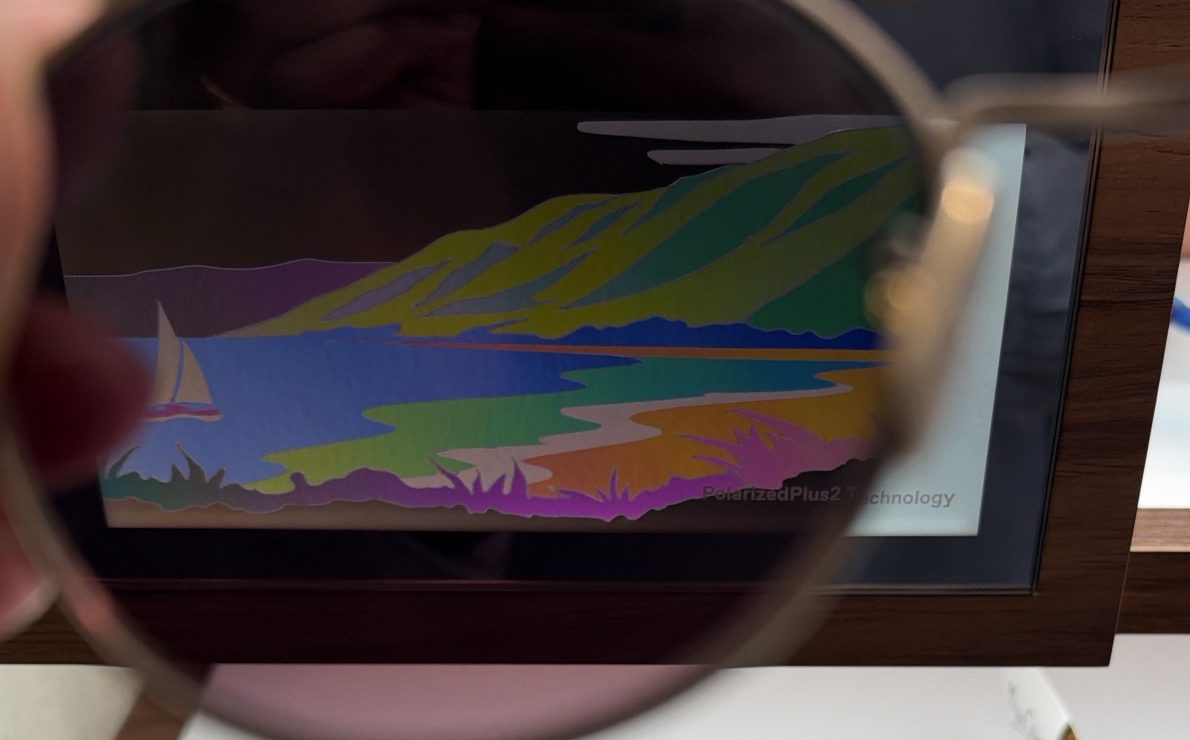
Sunglass stockists often use a polarised test card, like the Maui Jim card in these photos. To the naked eye it looks like a plain, milky panel. Look at it through a polarised lens and a coloured picture appears.
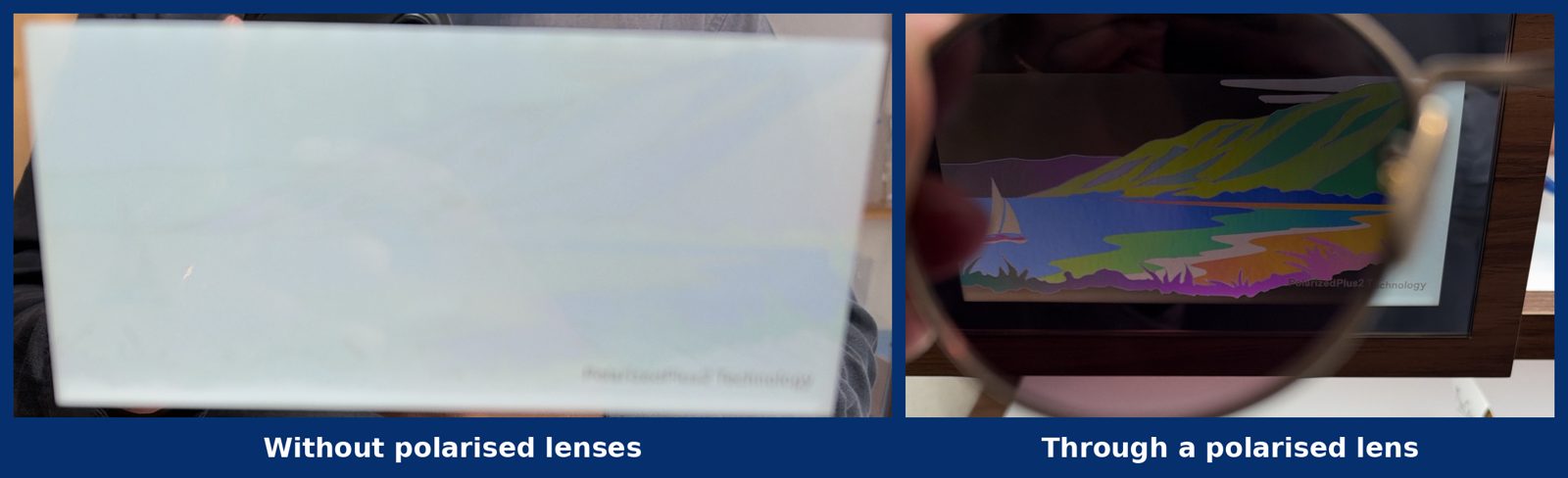
Cards like this are generally made from a polarising sheet layered with clear plastic films that twist polarised light by different amounts. Your eye cannot see that twist on its own, so the card looks blank. A polarised lens acts as a second filter and turns those differences into visible colours. Maui Jim does not publish exactly how its card is made, so treat this as the general principle.
Two quick home checks work too: tilt your head while looking at a phone or car dashboard screen through the lenses (many screens darken at certain angles), or hold two pairs of polarised sunglasses at right angles to each other and look through both (the overlap goes dark).
Is it better to have polarised sunglasses?
For bright, reflective conditions, many people find them more comfortable. In a small survey of 21 triathletes who tried both versions without knowing which was which, most preferred the polarised pair, although the answers were not statistically analysed [1]. The benefit is comfort rather than sharper vision: a 2025 laboratory study of 45 young adults found no significant difference in sharpness of vision, contrast sensitivity or depth perception with polarised compared with non-polarised sunglasses under controlled glare [2].
They suit people who spend time on or near water, drive in bright conditions, fish, cycle or work outdoors.
Which is better, UV or polarised sunglasses?
You need UV protection in any pair, and polarisation is an extra. They are separate features. A polarised lens does not automatically block UV, and a non-polarised lens can block UV fully.
Sunglass standards test them separately. When 646 CE-marked (European-labelled) sunglasses were tested at an Australian laboratory in 2003–04, 17.3% failed the European standard. Among the failures, 12.5% had polarisation alignment errors and 1.8% let through too much UV [3]. A study of 28 sunglasses and lenses found that protection at the top end of the UV range and in violet-blue light varied widely and did not track price or advertising claims. It also noted that the Australian/New Zealand standard requires UV blocking up to 400 nm [4]. Buy sunglasses that state they meet AS/NZS 1067.1 from a supplier you trust.
What is the downside of polarised glasses?
- Screens can look dark. Many LCD screens give out polarised light, so phone, dashboard or equipment displays can look dim or patchy at some angles. A case report described an emergency medical provider who could not see a video laryngoscope screen (a device used to place a breathing tube) while wearing polarised sunglasses [5]. With other screens the effect can be the opposite: in one bright-light simulation, polarised sunglasses made a video laryngoscope screen easier to see [6]. It depends on the screen.
- Patterns in some windscreens. Polarised lenses can show stress patterns in some car windscreens [1].
- No night driving. This applies to all tinted sunglasses. Under the international sunglass standard, lenses that let through less than 75% of light should not be used for driving at dusk or at night, and the darkest category 4 lenses are not suitable for driving at any time [7].
Why sunglasses matter in New Zealand
New Zealand and Australia have some of the highest UV levels in the world [8]. A United Nations expert assessment links UV exposure to cataract and pterygium (a growth on the white of the eye, sometimes called surfer's eye), and advises large or wraparound sunglasses that block UVA and UVB, together with a hat and shade [8]. In a meta-analysis cited in that assessment, people who wore sunglasses had about half the odds of pterygium, although that evidence is observational [8]. In a Western Australian study that followed young adults for 8 years, those who wore sunglasses at least half the time outdoors showed a faster fall in a marker of UV damage on the surface of the eye [9]. Read more in our guides to pterygium and choosing sunglasses for UV protection.
Maui Jim and polarised sunglasses at Rose Optometry
We carry Maui Jim, among other sunglass brands, at our practice at 38 Lake Road, Frankton, Hamilton. Maui Jim says its PolarizedPlus2 lenses block 99.9% of horizontal glare and 100% of UVA and UVB, and use a blend of three rare-earth elements to enhance colour and contrast [10]. Those are the manufacturer's own claims. Our team can compare lens tints with you and help you choose a frame.
If you wear glasses, a prescription is checked first. Book an eye examination (new patient) or book as an existing patient, browse our frames and lenses, or read what to know before buying prescription sunglasses. You can also call us on 07 847 3195.
Last reviewed 17 November 2026 by the Rose Optometry optometrist team, 38 Lake Road, Frankton, Hamilton. This article is general information and does not replace an eye examination.
References
- Mercatelli L. Examining polarizing and non-polarizing filters for road sports. Front Sports Act Living. 2023;5:1236473. PMID 37608966. doi:10.3389/fspor.2023.1236473
- Ebrahimi F, et al. Effect of polarized sunglasses on visual functions. Int J Ophthalmol. 2025;18(12):2325-2330. PMID 41280627. doi:10.18240/ijo.2025.12.14
- Dain SJ, et al. Sunglasses, the European directive and the European standard. Ophthalmic Physiol Opt. 2010;30(3):253-6. PMID 20444131. doi:10.1111/j.1475-1313.2010.00711.x
- Giannos SA, et al. Spectral evaluation of eyeglass blocking efficiency of ultraviolet/high-energy visible blue light for ocular protection. Optom Vis Sci. 2019;96(7):513-522. PMID 31274740. doi:10.1097/OPX.0000000000001393
- Smith AJ, et al. Use of polarized sunglasses during video laryngoscopy: a cause of difficult prehospital intubation. Prehosp Disaster Med. 2019;34(1):104-107. PMID 30626454. doi:10.1017/S1049023X18001164
- Hasegawa T, et al. Visibility of video laryngoscope in high-illuminance environment simulating outdoor conditions: effects of screen conditions and polarized sunglasses. JA Clin Rep. 2025;11(1):15. PMID 40029494. doi:10.1186/s40981-025-00778-9
- Loureiro AD, et al. Are sunglasses appropriate for driving? Investigation and prototype for public testing. Biomed Eng Online. 2021;20(1):43. PMID 33926478. doi:10.1186/s12938-021-00881-9
- Neale RE, et al. The effects of exposure to solar radiation on human health. Photochem Photobiol Sci. 2023;22(5):1011-1047. PMID 36856971. doi:10.1007/s43630-023-00375-8
- Lingham G, et al. Conjunctival ultraviolet autofluorescence area decreases with age and sunglasses use. Br J Ophthalmol. 2023;107(5):614-620. PMID 34815236. doi:10.1136/bjophthalmol-2021-320284
- Maui Jim. PolarizedPlus2 lens benefits (manufacturer information). mauijim.com
Recent articles
See things the Rose way
Make an appointment at Hamilton’s leading eye care specialists.

